+ 



|
Last
Updated |
09/20/2015 |
|
|
This young adult novel is a must read for mature
readers.The Fault in Our Stars is the story of Hazel Lancaster and
Augustus Waters, two Indianapolis teenagers who meet at a Cancer Kid Support
Group. Although this love story is melancholy and the ending inevitable, it
is the intelligence, humor, and spirit of the characters that makes this book
most memorable. Both Augustus and Hazel are the instruments of paradox: they
are too smart and to deceive themselves about their deaths. Their probing
minds don't deal sentimentally with the emotions and actions that most people
who have terminal illnesses deal with. Thus, the title from Shakepeare's
play, Julius Caesar. The fault, dear Brutus, is not in our stars, /
but in ourselves . . . These two main characters know that our life's
worth is determined by us and not by some outside force--in both its quality
and length. There are some tough parts--because you are totally drawn in and
care for all these characters. But I found myself laughing a lot.
The wit of a Hazel, Augustus, and Isaac is beyond compare. This is book
that I think will become a classic. |

|
|
Tracks
by Louise Edrich is a story about the disintegration of a Native American
Community, specifically in North Dakota, in a twelve year span of the early
20th century. The narrative is told in alternating chapters by two
distinct and different voices—Nanapush, an old and wise man of the tribe,
trying to live as much by the old ways as he can—and by Pauline, a mix -breed
orphan, who evolves from garnering reader sympathy—to a conniving,
self-serving, religious fanatic lunatic by the story’s end. The main character, Fleur, is the embodiment
of the struggle of the Indians to maintain their culture and way of life in
the face of unstoppable encroachment by the white man. Besides the facts of
the situations, the characters and events are intertwined and made more
complicated by gossip, superstition, and out-right lies. Fleur is the
only one of her family to survive when an epidemic hits the reservation. She
is rescued by Nanapush who has lost his own family, and so considers Fleur a
daughter. She is considered bad luck by reservation residents when after two
close drownings the men who had helped her--die. She goes to live in her
family's cabin on Mitchimanitou Lake. The people believe she keeps a sea
monster in the lake under control. She visits the butcher shop in town, and
joins the men there in playing cards. The men become very angry when Fleur
plays so well she takes all their winnings. A tornado strikes shortly after
this. The men are found mysteriously locked into a meat locker from the
outside. Only one survives, and he is crippled. This contributes to even more
fear of Fleur among the reservation residents. |
|
|
Morag Gunn is a middle-aged writer who lives on a farm in
northern Ontario. One day, she finds some pictures from her childhood, and
this sets off some memories that become the material and impetus for the
telling of her life story, The Diviners.
The word, diviners, has many
definitions. One of Morag’s neighbors, Royland, is a diviner of water—finding
wells. Many of the characters, including Morag assume the definitions of
diviners that include inspiration, intuition, and reflection. Morag’s parents
died when she was a little girl. They died of infantile paralysis (polio).
This was one of the saddest and loneliest of the memories. Morag was brought
up by Christie Logan, the despised town scavenger, and his increasingly obese
and inactive wife, Prin. Although they do not have much to give, Prin is kind
and Christie gives Morag a rich store of tales of a (probably imaginary)
Scottish hero, Piper Gunn. In fact, Christie is one of my favorite characters
in the novel. Uneducated and raw, he is still keenly bright and observant—and
some of his language and quips set the reader laughing. Like many of us when
we are young, Morag does not appreciate Christie until she is long gone and
it is too late. Determined to leave, Morag goes to college, where she falls
in love with, and marries, Brooke Skelton, a handsome professor fifteen years
her senior; he takes her to Toronto, where he has a new position and where
she sinks unwillingly into the life of a professor’s wife. Brooke does not
want children, and he patronizes her attempts to write. After much struggle,
Morag completes and publishes a novel. Morag accidentally encounters Jules Tonnerre, a half-breed
(Metis) who was her first high school boyfriend. When Brooke reacts jealously
to her friend, Morag moves in with Jules,which brings her marriage to an end.
This results in pregnancy. Although she cares about Jules, she knows he is
not a husband and wife kind of guy, so she moves to Vancouver, where she
bears her daughter, Pique, and continues trying to advance her writing
career. Her support comes from women: an old college friend, the friend’s
mother, a landlady who is an exotic dancer. Eventually, Morag goes to
England, where she writes, works in a bookstore, and has a frustrating
relationship with a painter. Throughout the story, Morag comes to realize how
her roots are heavily entwined in how she comes to view the world. Jules, with whom
Morag has lived for brief periods but who has never settled down, is worn out
by his life as a country music singer and dies of throat cancer. Pique, now
aged eighteen, has seen her father only rarely but feels bound to him as a
singer and as a Metis. She begins to take an interest in her dad’s family—and
unlike her mother—much earlier. Morag, who has been setting down all these
events on paper, realizes that this is the novel she has been trying to
write. |
|
|
This book is a page-turner for mature readers, only. It is fast-paced, full of violence and much sadness. Yet, is also has immense beauty and hope for the human spirit. The setting of A Fine Balance by Rohinton Mistry is India in 1975-76. This incredible novel reminded me, first, how our memories are often contaminated with feelings and sensations more than with facts. I remember hearing about Prime Minister Indira Gandhi in a positive light--as a breath of fresh air--a woman in charge of a large poverty-stricken country--one who would bring hope and positive change. In reality, Prime Minister Indira Gandhi defied a court order calling for her resignation, declared a state of emergency and imprisoned the parliamentary opposition as well as thousands of students, teachers, trade unionists and journalists. These events, along with the government's forced sterilization campaign, served as backdrop for an intricate tale of four ordinary people the reader will come to know and love. The story starts out with the sort of protagonist I love, a strong and independent female. Dina loves her pediatrician father who makes little money because he services the poor. She, too, unlike other girls in India, wants to become a doctor. Unfortunately, her father dies of a snakebite in an outlying province of the lower caste. Nusswan, her brother takes over as head of the family. Unlike his father, Nusswan is small-minded and traditional. When he picks a husband for her, Dina surprises him with a husband of her own. It is this brief marriage that provides Dina with happiness. Her husband is killed in a bicycle accident and she refuses to return to live with her brother and his family. So she starts a seamstress business to support herself. When her eyes go bad, she hires a couple of tailors to help her. Ishvar and his nephew Omprakash, whose father, a village untouchable, was murdered as punishment for crossing caste boundaries, have come to the city to escape their hardship. Along with them, Dina rents a room in her house to a naive college student, Maneck, whose parents' general store is failing. This, too, is a sad sub-plot that goes along with struggle for survival that all of the characters face. With great empathy and humor, the author describes the heroism of India's working poor, who deal with corruption, social injustice and stupid policies. He describes the effects of poverty, caste, superstition, corruption and bigotry. The reader comes to love, laugh, and suffer with the four main characters who struggle to survive. In the end, even though they all come from different classes and circumstances, different religions and means, they come to understand that the only thing that matters is being human--and this is the connection that matters. |
|
|
The
Apprenticeship of Duddy Kravitz by Mordecai Richler takes
place in the 1950's in Montreal, Canada. Duddy is a character that you will
both love and hate. Born into a laboring class Jewish family, Duddy sets out
to get rich and buy land. Strongly influenced by his grandfather, the zeyda,
Duddy takes to heart the phrase, if you don't own land, you
ain't nuttin'. So Duddy gets into a strange, and hilarious,
film-making business. His pushy and obnoxious behaviour both appalls and
endears everyone he meets. Richler writes a satire about Duddy's lust for
money, power, and land, but the satire also applies to society, in
general. Duddy's dad, Max, spends much of his life admiring Jerry
Dingleman, the Boy Wonder, a local guy who,
on the outside, appeared to have risen out of poverty and become a wealthy
tycoon from his ingenuity and hard work. We find out through Duddy that
the real Boy Wonder isn't so great as the
imaginary one Max and his friends have conjured up. The same is true
for many other "rich" folks that Duddy meets along the way. The
only loyal and intensely good friends Duddy has--Yvette and Virgie--are the
very ones he treats the worst. The stories, characters, and predicaments
are often touching and often very funny. Duddy moves in and out of these
people's lives, motivated by one thing--getting ahead. Duddy's Uncle
Benjy is the one person who seems to have Duddy figured out. When he
dies, he leaves him his house--but no money. He also leaves him a
letter that sums up this larger than life person, Duddy Kravitz: There's
more to you than mere money-lust, Duddy, bu I'm afraid for you. The scheming
little bastard I saw so easily and the fine, intelligent boy your grandfather
saw. But you're coming of age soon and you'll have to choose. There's a brute
inside you, Duddel--a regular behemoth--and this being such a hard world it
would be the easiest thing for you to let it overpower you. Don't, Duddel. Be
a gentleman. A mensh. |
|
|
Oh my, I loved this book so much. Life of
Pi by Yann Martel has everything: great story-telling, great writing,
great humor, great philosophy, great religion, great compassion, great
sorrow, great adventure, great nature, great imagination, great
love. The main character Pi Patel grows up in Pondicherry, India--the
son of a zoo-keeper and an intellectual mother. Pi is an extraordinary and
precocious child who pays attention and asks questions about life's meaning.
His atheist parents are mystified when they are confronted by the Catholic
priest, the Imam, and the Hindu pandit. It seems that Pi has joined all
these religions. His sarcastic brother teases him about joining four more so
that he can be on holiday everyday of his life. The irony of his simple
answer to these adults about which religion he will choose could be the theme
to the book: I just want to love God. Due to political uprising, his father
sells off a majority of the zoo animals to various zoos in America. The
animals are loaded onto the same boat that the family will take to reach
Winnipeg, Canada. On the journey to North America, the boat sinks. Pi is the
only human survivor to make it aboard a life boat--accompanied by a few
animals, including a 400 pound tiger named Richard Parker. The tiger's
name is the humorous result of mix-up in the bureaucratic government
paperwork that accompanies business transactions in any despotic state. It is
this journey in a lifeboat with a tiger aboard that provides the adventure .
Pi's earlier training with animals in the zoo and his quick mind make an
improbable fantasy believable and thrilling. But it is Pi's soul and heart
that make the reader cry and laugh and love--and, as the the narrator relates
in the beginning--make you believe in God. |

|
|
This
book is not for the weak-hearted. The first in an epic series, A
Game of Thrones by George Martin is full of violence, death, and
destruction. It is also, however, full of honor, hope, and loyalty.
Although the genre is fantasy, the narrative intertwines historical fiction,
chivalry, mystery, adventure, and spiritual overtones. Each chapter is from
the point of view of one of the eight main characters--each of them related
to the action and plot in some fashion. Each of these main characters is
surrounded by many more characters who the reader also comes to know--and
love or hate. Some of these characters act heroically, exhibiting compassion,
self-sacrifice or service. Some are craven, inexperienced, selfish, and
unwise. Some are witty and funny. But in the end, they are mostly human--like
all of us--wanting not to be alone--knowing that as humans--the life we know
does come to an end. I recommend this for MATURE readers, only. |
|
|
Ray
is from a Polish neighborhood where the white guys in his high school go out for
wrestling and the black guys play basketball. Ray does not fit the
stereotype. He loves basketball and that is what he wants to do.
For three years in a row, he tries out for the team, but the coach has
something against him, and try as he might, he never gets picked. Ray doesn't
give up, and finally, in his senior year and with a new coach, he makes the
team. His troubles are just starting, however. His white friends don't
think he belongs in basketball, and his new black teammates don't want him on
the team, either. Ray struggles to understand prejudice and learns a
great deal about himself in the process. This book gives a teenager a
lot of fuel for conversation. Ray dates a beautiful cheerleader and
finds out that her beauty is only skin deep. His best friend, Walter,
has been totally shaped by his own bigoted father, and he is blatantly
prejudiced as a result. In fact, he gets Ray into a violent confrontation
between the two groups. The coach, who appears impassive on the surface,
works to get his team to be the best basketball players they can be.
The players don't understand, however, that the coach is also working to get
them to be decent human beings. Ray and his counterpart, Robert, are
always at odds, so when the coach makes them work out together
everyday--alone--they have to adjust. This has a surprising
consequence. One of my favorite parts has to do with the relationship
between Ray and another--non-cheerleader-type girl named Sarah. She is bright
and thoughtful, and when he begins to pay attention, Ray notices she is
beautiful--the kind that is inside, as well as outside. |

|
|
If
you are looking for spy fiction, then
John le Carre is the author you want to read. He is the espionage
writer's writer. Perry and Gail, a bright and beautiful young couple
from England, go to Antigua to make some life-decisions about their careers
and possible marriage. They get caught up with a Russian gangster who
wants to defect to England. Of course, the plot becomes intricate as the
two--Gail and Perry--become entangled with the British Secret Service and the
family of the Russian defector, Dima. One of the best things about Le Carre's
writing is that the reader cannot ever pinpoint the "bad
guys." Those who work in espionage have a wavering moral compass
that can make them decent sometimes--and at other times--anything but decent.
Even as as a reader, you start to get paranoid and are not sure you can trust
anyone. However, the story is a page-turner. Perhaps it is because John le
Carre was, himself, a member of the British spy angency, M16, that he is just
so good at this. |
|
|
The Disappearing Spoon and Other True Tales of Madness, Love, and The History of the World from The Periodic Table of the Elements by Sam Kean is a non-fiction book for science and history lovers--especially those who have an interest in the periodic table. Here is a quote from the author: We eat and breathe the periodic table; people bet and lose huge sums on it; philosophers use it to probe the meaning of science; it poisons people; it spawns wars. Between hydrogen at the top left and the man-made impossibilities lurking along the bottom, you can find bubles, bombs, money, alchemy, petty politics, history, poison, crime, love, even some science. With a sense of humor, biting satire, and great knowledge of chemistry, Mr. Kean takes each element and tells a story of its history and discovery. He mixes the science and history with the reality of politics, economics, and man's ability to do great good and/or great harm to humanity. For example, when he gets to the elements tantalum and niobium, heat-resistant and non-corrosive metals that make them vital for cell-phones, Kean lays out the exploitation of the Democratic Republic of Congo (formerly Zaire)--what people will do to their environment and their fellow man to make money. I recommend this to good readers who love chemistry. |
|
|
Mark
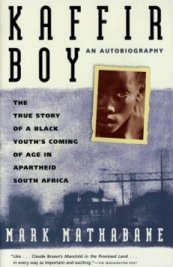
Mathabane's Kaffir Boy: The True Story of a Black Youth's Coming of Age in
Apartheid South Africa was published first in 1986. It is the revelation
of the horror and inhumanity that occurred in South Africa from 1948 until
1994 under a system of government called Apartheid. Through this young
man's story and voice we see the squalor, the hunger, the suffering, the
torture, the unspeakable degradation that the white government forced on the
black townships, notably Alexandra--the ghetto where the narrator
lived. Kaffir is a derogatory name whites use for blacks in South
Africa. "The word Kaffir is of Arabic origin. It means
'infidel.' In South Africa it is used disparagingly by most whites to refer
to blacks. It is the equivalent of the term nigger. This young man's
only ticket out of this life is "education." It is difficult
to read this book. Often, the reader, along with the narrator, experiences
so much sadness, that all hope seems lost. Then, out of
nowhere--perhaps the smile of one of his little sisters as they play with
rocks--hope arises and lets us see a hint of beauty--of possibility--of
escape. Readers need to be mature and aware that many of the atrocities
of this story are brutal. Until I read this book, Apartheid had only been a
word I had studied in a world history class. Reading this man's memoir
gave me a vivid picture of a time and system that makes me sad--but also a
picture of the few brave and wise and good people who fight against such
treachery. |
|
|
Antonio Márez is only seven years old, and he is wise beyond his
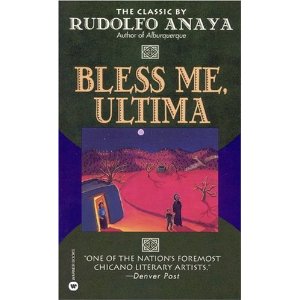
years. Bless Me, Ultima by Rudolfo Anaya is told through his young and
innocent viewpoint. His father is a former vaquero who has wandered the
great prairies of New Mexico and Mexico, the llano. His mother is from a
family of farmers who stay put and plant crops. There is much conflict,
both spoken and unspoken, in the family about which is the better life.
The Marez family takes Ultima in to stay with them in their small house on
the edge of the IIana in Guadalupe, NM. She is a healer and has done much to
help their family in times past, and now she is an old woman and is in need
of a home. Many of the villagers are skeptical of her because of her
powers, and many call her a witch. Antonio spends a happy time with Ultima,
learning about plants and herbs that promote healing. But one tragedy
after another begins to fall the community and Tony's family. Each of these
tragedies is experienced by Antonio and represent the loss of his innocence.
First there is crazy Lupito, shot to death by a mob for the revenge of his
murder of the sheriff. Tony follows his dad to the bridge and witnesses
the whole calamity. Along side all of these disasters, Antonio is
learning about the Church--his mother is ultra religious, and she has great
aspirations for her son to become a priest. Tony's friend Florence does
not believe in the teachings of the Church and even Tony's dad seems to
worship the earth more than he abides by religious teachings. All of these
inner struggles are mitigated by Ultima, who tells him all the time that it
is "being a good person" that is what matters. Meantime, the
most horrible villain is a man named Tenorio. He is determined to kill
Ultima because he thinks her magic is responsible for the death of his
daughters. He is frightening in every way, and I found myself full of
fear whenever he appeared on the pages. This is a great story, although
somewhat complex. It would be helpful to be familiar with Catholic
terminology, but most good readers would do alright, even without that
familiarity. |
|
|
This is a great read, at times--frightning,
exciting, funny, touching. It is a wonderful historical novel.
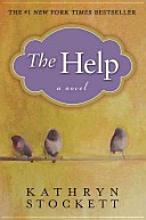
The Help by Kathryn Stockett
takes place in the segregated South in 1962. Although this is nearly one
hundred years after the Civil War, the culture of the time still has African
Americans living as second class citizens. Almost all middle class
white families employ black domestics, underpay them, give them tremendous
responsibility, including raising their children. Skeeter, one of the
story's main characters, is a young white woman who has just graduated from
Ole Miss. Much to her mother's chagrin, she is still not married and is
ruining her chances because of her independent nature. Skeeter wants
to be a writer. She gets a job at the local newspaper as a columnist--giving
housekeeping advice. She enlists the help of her high school
friend's maid, Aibileen. However, when she begins the interviews
at Aibileen's house, the interviews quickly turn to a subject much more
important than housekeeping--instead, to the discrimination, abuse, and
hatefulness that the Negro community must endure. These evening
conversations grow into a community of people, including Aibileen's best
friend, Minnie. This is dangerous business for all of them, as it occurs
at the height of the rise of Klu Klux Klan and takes place at the very time
and place where Edgar Medgars is murdered. Amidst the intricate stories is a
plot that builds with excitement--and also adds humor to very serious times
and circumstances. |
|
|
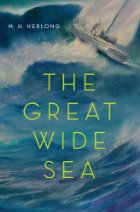
To be honest, I bought The Great Wide Sea by
M.H. Herlong at a local bookstore last week while I was wandering
around the young adult literature section looking for books that boys would
like to read. I just finished reading this book and I am literally out of
breath. What a story--for boys, girls, men, women, anyone. If it's exciting
action you seek, how about this: a father, grieving over the death of his
wife, sells his house, buys a sailboat, and takes his three sons ages 15, 11,
and 4 on a year long trip to sail around the Bahamas to rid himself of the
pain. The father disappears off the ship one night, the boys are left to
navigate on their own through a violent storm that crashes their boat and
leaves them deserted on an island. Their struggle for survival puts this into
the category of survival literature--but the book is much more. It is
the story of family relationships--the worst and best part of these
relationships--of decision making--of harshness and tenderness--of hope and
despair. It is a sea story--and the reader learns much about sail boats, gear,
navigation--even about the Bahamas. But maybe the best part is how each
character changes--what the events do to make them such different human
beings than those characters who appeared on the first page. Yet there is
something more powerful than each of them that holds them and this book all
together. |
|
|
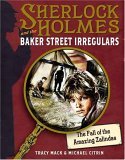
The Sherlock Holmes of Arthur Conan Doyle is the
most famous detective of all literature. As a contemporary takeoff of
Sherlock Holmes, this is the first in a series of the Baker Street
Irregulars--The Fall of the Amazing Zalindas. Here is a gang of
orphaned boys who live in London during the Victorian Age--the 1800s.
This was a time of much poverty in the city--much crime and corruption.
Children were forced to work in factories and coal mines--to do hard
labor. This particular group of kids evades the authorities and lives
on their own--not far from the home of the famous Sherlock Holmes. From time
to time, he gives these boys work. The plot is exciting. The famous Zalindas
of the circus have fallen from the high wire and plunged to their deaths.
Suspicion of foul play is aroused, and Sherlock Holmes is called in. Since
the Baker Street Irregulars are children of the streets, they are very good
at spying and acquiring information, so Mr. Holmes hires them to hang out at
the circus and pick up any evidence or information they can. There is threat
and danger at every turn of the page--and these boys have learned a great
deal from Sherlock Holmes about crime scenes and criminal minds. Ozzie,
one of the newer members of the gang, is especially bright and is a budding
Sherlock, himself. I thought this book had an element of fright that
would entice most any one who likes to be a bit afraid when he reads. |
|
|
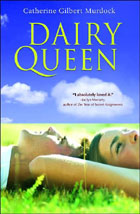
What a fantastic read--Dairy Queen by Catherine Gilbert Murdock. The narrator of the story, and on whom all the action centers, is a loveable, sympathetic, hard-working, anxiety-ridden, athletic, and very funny teenage girl named D.J. As a reader, you are drawn into the story with D.J's first person narration. You are scared with her, confused with her, lonely with her, mad with her, joyous with her, and laughing with her. The setting is a dairy farm, where D.J.'s father has been hurt in a machinery accident. She is the only child left to do most of the work--the milking, and all the other countless back-breaking chores of farming. She lives in a family of football players, including two brothers who are off playing Division I and professional sports. However, the whole family is dysfunctional when it comes to talking. They keep everything inside--until it explodes. At the start of summer, D.J. gets an unexpected helper. An old friend of the family, who also happens to coach the neighboring town's football team, sends over Brian Nelson, his team's quarterback, to assist the Schwenks. This relationship starts with great disdain – neither of them wants to be with the other one. It is this relationship that changes both of them and is the basis for most of the drama, including D.J. deciding to play football in the fall on her own high school boys’ team.This is a book about growing up, about small town living, about sports and sports rivalry. But mostly it is just great fun to read. This book is for MATURE readers only, due to some strong language and serious themes. |
|
|
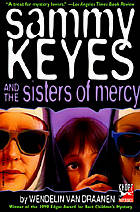
Samantha Keyes and the Sisters of Mercy by Van Draanen was a blast to read.
Lots of students check this series out, but this is the first time I have
picked one up, and now I see why they are so popular. Sammy is somewhat
of a renegade for her 13 years. This story starts with her serving
community service instead of detention for misuse of the Public Address
system at school. She is sent to the catholic church and to Father
Mayhew at St. Mary's to do her penance. When his precious wooden cross
turns up missing, he blames her. Sammy sets out to prove she is not the
thief--and what a ride she takes us on. We are introduced to some outlandish
characters including a troupe of dancing nuns, a crotchety old nun named
Josephine, a homeless girl who lives in a refrigerator box, and a host of
other colorful odd ducks. On the home front, Sammy's life is not exactly
ordinary, either. Left by her mother to live with her Gram, this is the
only mother she has really ever known. And since Gram lives in a high
rise for Seniors where children are not allowed, Sammy must sneak in and out
of the apartment by way of the fire-escape. Sammy has a passion for
softball, along with a couple of her schoolmates, Dot and Marissa. Sammy's
catcher's mitt is the only piece of her father that she owns. When a
jealous member of the opposing team steals her glove, it is everything she
can do to concentrate on catching the ball. If you like mystery,
exciting sports-play by play--and stories about even-handed justice, this book
is for you. |
|
|
This is a short and rousing story about a young girl
named Lidie who loves to ride horses. It starts out with Lidie leaving her
home in Brazil to join her father and brother in America. They have not
been together since Lidie was little and since her mother died. She
speaks Portuguese and only a little English. In Brazil, she has been living
with her aunt and uncle and has had a lot of freedom to become an expert
horsewoman. Her father and brother have both been working as horse trainers
in New York, and so she is excited to show them what she has learned since
they last saw her. Unfortunately, when she arrives in her new home, she
has a lot of "unpleasant" surprises. First off, her dad and brother
seem to think that she is still five years old--and they have decorated her
room in pink frills. She is sent to a school where her insufficient English
skills result in a very embarrassing episode, and she is given a horse to
learn to ride--a gentle, old horse that would be used to teach even the most
novice of horse riders. Even though both her dad and brother can speak
Portuguese, Lidie, her dad, and her brother have emotional hang-ups that keep
them from being honest with each other. This is an exciting, easy read
for all our students at South. |

|
|
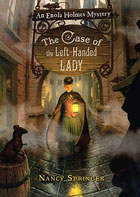
The Case of the Left-Handed Lady by Nancy Springer is for better readers. Enola
Holmes (Her name spelled backwards is "Alone") is the sister of
Sherlock Holmes. This is Victorian England and girls are expected to
act like ladies, go to finishing school, get married, and become
domesticated. Enola, like her mother, is not interested in this life
path. Much to the dismay of her brother, the famous Sherlock Holmes,
she has run away and is living her own little secret detective life in
different parts of London. She sets up an office of a fictitious Dr.
Rogostin and acts as his secretary, disguising her own detective work. In this
story, she not only is forced to change identities to hide from her brother
who is looking for her, but she is also pursuing a dangerous case of a
missing young aristocrat. Lady Cecily has disappeared from her parents'
mansion, and Enola is determined to find out what happened to her. Like
her brother Sherlock, Enola is smart, creative, brave, methodical,
industrious, and kind-hearted. She outsmarts her brother several
times. It is not necessary to have read the original Sherlock Holmes
mysteries to get a flavor of the style and time period, but it is
helpful. If you love mysteries and are an above average reader, you
will enjoy this book very much. |
|
|
Ben Mikaelsen's Tree Girl is a chilling
account of the Mayan genocide that took place in Guatemala in the early
1980's.The violence in this book is vivid and heartbreaking, and I only
recommend this book for mature readers. You will need tissue--for the crying
you will do. The main character, Gabriella, lives with her family in a small
village where everyone is a family and love abounds. Gabriella loves to climb
trees; she loves to go to school, and she loves her freedom. There have been
rumors of government and guerilla warfare, but until the day her brother is
taken away by the military, her family has managed to avoid the horror.
Shortly after that, her little school is discovered and soldiers beat and
brutally murder her teacher. When she is away from the village one
day, nearly all her family and village inhabitants are murdered.
She and her sister set off to flee for Mexico, and while she sneaks into a
town to get food and water, she is forced to climb a tree to find safety from
an unspeakable massacre. When she finally exits the tree, her sister is gone
and she joins others as they make their way to the refugee camps in
Mexico. Based on a true story, this compelling historical fiction will
give readers an inside look of what it feels like to be a refugee, to be
homeless, and to be without hope. |

|
|
Deep
and Dark and Dangerous by Mary Downing Hahn is a spooky and tragic tale
that gives the reader a feeling of uneasiness. One day Ali finds a picture of
her mother and her Aunt Dulcie when they were young. It looked like
there was another girl in the picture--but she had been torn off--leaving
only the letter "T" as a clue to that girl's name. Ali's
mother, Claire, swears she has no idea who the other person is--and she will
not talk about it. Shortly thereafter, Aunt Dulcie comes to visit. She
is there to ask Ali to come with her and her daughter, Emma, to the cabin by
the lake in Maine, where she and Claire spent their own summers when they
were children. She wants Ali who is 12 to babysit for 4 year old Emma, while
she works on her painting and art work. The minute Ali's mother hears
about the cabin, she becomes distraught and says, No--that place is deep
and dark and dangerous. In the beginning, Ali and her father think Ali's
mother is over-reacting, and that it will be a perfectly safe place for Ali
to go. However, once there, Ali and Emma discover the deep, dark secrets of
their mothers' past. |
|
|
Dragon Road by Laurence Yep is the latest in the series of Golden
Mountain Chronicles--all stories about Chinese Americans and their
immigration to America, San Francisco, in particular. This story takes
place in 1939 at the height of the Great American Depression. It would
be helpful to understand this time period before reading the book, but not
necessary, as you will find out a great deal about how hard it was to live and
make a living for anyone during those years. The main characters, Cal
and Barney, live in poverty in Chinatown. Their only escape from the
drudgery of their lives is to play basketball. They pick up games
wherever and whenever they can--and they bet money on the outcome, making a
little precious cash to help them survive. One day, they are observed by a
couple of professional con-men, who talk them into joining their travel
team. This team journeys all over America, picking up games, sometimes with
other professional teams, and sometimes with locals who love to play
basketball. Poor as people are, they will often pay their last nickel
for entertainment in a local gym. It is during this travel that Cal and
Barney learn about the prejudice that exists throughout the land--prejudice
for anyone who is not considered "American" or
"white" enough. Their team (the Dragons) becomes quite
famous--and even meets up with and plays against the Harlem Globetrotters at
one point. The team members are characters who have their own stories--and
part of this novel relates to their interaction with Cal and Barney.
Having been eager to escape Chinatown and get to where the "grass is
greener," these two boys find out that things at home are not any worse
than they are in other places. In some ways, the people and friends in
Chinatown are better than what either of them imagined before they joined the
Dragons. If you like basketball and history, you will like this book. |
|
|
If you like exciting, harrowing, scary, dangerous,
and smart, you will love this book. Thirteen year old Ingrid is a
detective. When her grandfather is accused of murder and put in jail,
Ingrid sets out to prove his innocence. Proving his innocence is
tough--he is not exactly the cooperating type. Plus, even her dad (his son)
thinks Ingrid's grandpa should accept a plea bargain from the shoddy lawyer.
A fan of Sherlock Holmes, Ingrid is always quoting Holmes: Data,
Watson, data! I can't make bricks without clay! The more snooping
she does, the more deep dark secrets she finds. Grandpa is one of five
World War II veterans who have stories to tell about their heroic exploits.
No one has ever interviewed them in detail until now--and their connection is
part of the dark secret that is connected ultimately to the murder,
itself. As the story advances, someone is watching Ingrid as she gets a
little too close to the truth. When Nigel, her dog, is stolen, she goes
after him. The climactic action builds as she comes face to face with
the villain/s. At the same time as this whodunit is occurring,
Ingrid is in the local production of Hansel and Gretel. It is no
accident that the title of the book mirrors the journey of the fairy tale
classic as well as the course Ingrid takes in her real life. |
|
|
Camel Rider by Prue Mason is an exciting story about two young boys whose
accidental meeting changes both of their lives. Adam lives in a gated
community in the United Arab Emirates. Although the city's name is
fictitious, it is much like Dubai, very rich and near the coast. Adam and his
family are originally from Australia. Everyone who lives inside the gated
community is a foreign national. Adam's mother does not want him to go
to high school here, and so when the story opens, he and his mother are
supposed to be leaving for Australia--back to his homeland--for him to start
school. But Adam loves it here. He has a lot of friends. This
place is close to the sea, and he and his friends have become great
surfers. So he hides his passport in his dad's suitcase (his dad is a
commercial pilot), and his mother is forced to leave him home alone while she
goes back to Australia. Now he has a few more days of freedom before his dad
gets home with his passport--and before he takes the consequences for his
behavior. He is just getting dressed when he hears military planes attacking
the city. Everyone in the neighborhood packs up in an attempt to get out
of the country as quickly as possible. The English neighbors tell Adam
that he must come with them--but they have no room for his beloved dog, Tara.
They make it over the border and are stopping for gas and a bathroom break,
when Adam steals away and sets off on foot to go back for his dog. It
is in this barren wasteland of heat, treacherous terrain, and unrelenting
desert sun, that he meets up with "Walid," an Arabic boy who has
run away from his slave-owners. He has an amazing story of his own.
Walid only speaks Arabic, and Adam only speaks English. It is the great
need and danger they are both in that puts them on a quest for survival. In
addition to an exciting plot, the story issues a wonderful theme. If
young boys who do not communicate in the same language--and who have very
different cultures--can get along, then why can't grownups with the same
differences get along. |
|
|
The setting of Beverley Naidoo's Burn My Heart
is in Kenya in 1950. Times are dangerous, due to an uprising of
native Kikuyu (the Mau Mau Rebellion) against the colonization of Kenya
by the British (called Wazungu). The story starts with Mathew and Mugo as
best friends, even though Mathew is white and the landowner's son, and Mugo
is black and the stableman's son. Like many boys their age, they like to
explore and have fun. Mugo has taught Mathew how to make a slingshot, a ball
from banana leaves, and has also taught him much about the animals and
predators. Until now, Mathew and his family and Mugo and his family have been
loyal and trusting with each other. One night, when Mugo goes outside
his hut, a band of black revolutionaries arrives and forces his parents, as
well as all the laboring class in the village into a barn. There they
make them swear to be loyal to the uprising, to cease their loyalty to the
landowners. Mathew, in the meantime, has become friends with a white boy
named Lance whose father is in the military police. Lance has no time
for the black natives, and he taunts Mathew for his kindness to Mugo and his family.
Meanwhile, the white people in power are strengthening their domination and
trusting none of the Kikuyu people. Matthew's dad resists at
first. So does Mugo's dad. They are decent men caught up in
something way beyond their control. One weekend, when Lance spends the
night at Mathew's, Lance shoots a bird that Mugo calls a "go-away
bird." These sorts of birds fly away when there is a predator and
thus warn people of danger. Mugo considers shooting this bird bad luck
and says so. Lance hears him and degrades him and Mathew for ever
listening to this black kid. He pressures Mathew into starting a fire
in the shed next to the cornfield where they will cook and eat the
bird. Mathew knows this is wrong. During the night, everyone wakes up to
the cornfield on fire. In the greatest betrayal of all, Mathew blames the
fire on Mugo. Now both of their hearts are broken. This war (and all
wars) burns everyone's heart. |

|
|
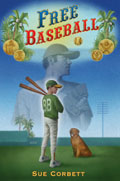
Felix loves baseball, and it's no wonder. His father
had been one of Cuba's best national players. But Felix doesn't know
his dad. And his mother avoids the subject. Now living in Florida with
his mother, Felix is determined to find out more about his dad. When a
team with a few Cuban players comes to town, Felix sneaks into their locker
room. They mistake him for their new batboy--and there the adventure
starts. He runs away with this team (by way of hiding in the luggage
compartment of the bus) in hopes of staying only a few days to find out more
information about his dad. It is in this new setting that he learns bits and
pieces about what became of his dad. And it is in this new setting that
he meets some wonderful characters--guys who love baseball just like he
does--and a dog named Homer. Homer is the mascot for the team and runs
the bases whenever one of the home team's players gets a homerun. When his mother
finally tracks Felix down, she tells him the truth about his dad. His
father helped his mother and Felix escape from Cuba when Felix was just a
baby. He sacrificed his own career to give the two people he loved a
chance at a better life. This story gives the reader a peak at what it feels
like to be an immigrant. This is a story of the American Dream. |
|
|
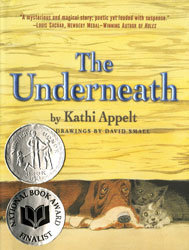
My, oh my! This book award finalist and
Newbery Award Honor book is simply an amazing work. The Underneath by
Kathi Appelt should be read by everyone, not just kids. First off, the
story (stories) are exciting page-turners. The story of Ranger, Puck,
and Sabine is not unlike the "Lassie Come Home" episodes I used to
watch on television as a child. Gar Face is the villain extraordinaire. The
story of Night Song, Hawk Man, Grandmother snake, and Alligator King is
native American myth at its best. But the best part is how these
creatures, as well as the trees and all parts of nature are part of a larger
and more divine design of love and survival, of time and space, of grief and
joy, of anger and peace, of broken-ness and healing, of being or not-being.
All of these stories show us how desire can work for and against us.
This is a book that will surely become a classic. I am envious of this
author's writing ability and look forward to more of her stories. |
|
|
This historical novel about the beginning of the
Civil Rights movement reminds me of how tragedy and great suffering
must often occur in order to invoke social justice. Hiram returns to
Greenwood, Mississippi to visit his grandfather who he lived with when he was
a little boy. His memory of his childhood in this peaceful little town
is very different from the reality he finds when he returns as an older boy.
Hiram meets Emmett Till, who is a 14 year old Negro boy, visiting his own
family in Greenwood at the same time. Hiram also gets reacquainted with one
of his childhood friends, R.C., who has grown into a bully. One day when they
are out fishing, Hiram witnesses R.C. abuse and threaten Emmett. Through the
town gossip, Hiram hears that Emmett has been accused of whistling at a white
woman, a total taboo in that time of segregation and racism. A few days
later, Emmett's mutilated body is found and two white men are accused of his
kidnapping and murder. There was an unidentified third person involved,
and Hiram is sure this must be R.C. Based on these actual events: the
lynching of Emmett Till, the trial and acquittal of the white men, the all
white male jury, the prejudiced cross- examination of the black witnesses,
and the eventual picture of Emmett Till's mutilated body in a Chicago
newspaper, this story is told through the eyes of Hiram. He sees now why his
own dad wanted to get away from Greenwood and live in a different part of the
country. He sees the discrimination and racism in his own grandfather
and many of the people in Greenwood. However, he also notices that even
the prejudice people, like his grandfather, have some redeeming
qualities. This exciting novel by Chris Crowe reminds readers that we
do not often notice our own prejudices--that it is easier to spot other
people's faults than it is to spot our own. |
|
|
Inkheart by Cornelia Funke is fantasy, but I forgot. From the first page, I
was so drawn in by the mystery and the language that I believed it all.
Meggie's father, Mo, can read characters out of books. When Meggie was
only three he read from the story Inkheart, and not only did he bring
the evil Capricorn to live in this world, he also inadvertently sent Meg's
mother into the book. Capricorn and his henchmen get great pleasure out of
murdering people. The story opens when Meg is 12 and Capricorn sends
Dustfinger to find Mo and bring him to Capricorn to read another evil
character out of the book. Thus begins the chase and capture, hiding
and scheming, escaping and planning. Many side-stories are woven into
the main thread of the story, as well as some wonderful and unforgettable
characters, such as Aunt Elinor and Fenoglio. This book is seriously
scary, and I think that is why kids love it so much. |

|
|
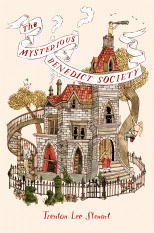
The Mysterious Benedict Society by Trenton Stewart is not for the
weak-hearted. Reynie, Kate, Constance, and Sticky are the four main
characters. These orphans respond to an add that is looking for
"gifted children for special opportunities." They are put
through a series of very difficult tests and beat out several other
students. Each test takes them to a new level of mystery until they
finally pass the scrutiny and end up with Mr. Benedict who trains them to be
spies. They are sent to a school/orphanage on a deserted island to find
out the evil secrets of Mr. Curtain, who plans to take over the world.
Not only does Mr. Curtain plan to take over the world, but in the process, he
is using technology that will brain wash everyone and make people lose
memories of all that is important to them. These four characters are gifted
in different ways, and the secret to their success comes in the way they work
together to solve their complicated predicaments. The story is
exciting, scary, adventurous, and fun. |
|
|
I am deeply embarrassed by any time in our nation's
history when the majority of people (white Americans) have reacted to another
race with fear, hate, prejudice, and superiority. In this genuine portrait of
what it was like to be a Japanese American in 1941 when Pearl Harbor was
bombed, the reader gets a first-hand description of what happens to Sumiko
and her family as they are separated, jailed, put in relocation centers,
taken away from their livelihoods, and generally humiliated. This story
begins with Sumiko receiving an invitation to a classmate's birthday
party. She is thrilled and daydreams about the fun she will have.
When she arrives at the (white) girl's house for the party, she is met by the
maid and the mother who turn her away. Apparently the invitation had
been to everyone in the class, but the mother had not known that there was a
Japanese girl in the class. Shortly thereafter, Pearl Harbor was bombed and
over 120,000 Japanese Americans, most of them all along the west coast, were
sent to internment centers across the country. I learned so much from reading
this book, Weedflower, by Cynthia Kadohata. Did you know
that the Quakers were the only religious group in America to publicly
denounce the detention of Japanese Americans? Sumiko's family
ends up in Poston, Arizona on an Indian reservation--where we are introduced
to more mistreatment of mankind by the ruling class. Of course, as terrible
as human beings can be to each other, they can also be full of kindness and
decency. It is in this place on the desert that flowers and people
bloom. |

|
|
This is another one of those BRING A BOX OF KLEENEX
books. Evyn and her brother Mackey have been raised by their hippie father,
Birdie. Their mother died when Evyn was only one. She loves her life in
Maine with her best friend Jules and her dog, Clam. When her dad drops
the bomb that he will be marrying a college professor named Eleni, a divorced
woman with six children, and they will be moving to Boston, Evyn comes
unglued. Evyn's imaginary conversations with her deceased mother usually help
to settle her down--her mother is always telling her to let anything that
hurts her "bounce" off her. But this situation is so oppressive,
nothing seems to help. Seen from Evyn's point of view, the new family
is a nut-case, the step-mother is totally unsuitable for her father, the new
school she must attend is full of snobs, the father she has always loved so
much is a changed man--and one she can no longer confide in. Full of pathos,
humor, excitement, and a very realistic look at blended families, the
author has created a story that will keep you turning pages and, at times,
crying your eyes out. |

|
|
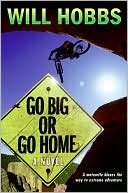
Will Hobbs is one of my favorite authors of adolescent literature. Imagine my surprise when I opened this book and found that it is set in the Black Hills of South Dakota. In fact, the place names--Spring Creek, Mickelson Trail, Hill City, Crazy Horse, Mt. Rushmore--all a few miles away from my home as the crow flies. Brady Steele decides to sit on the garage roof one night and watch the predicted meteorite shower. Spectacular as it is, he grows chilly and is about to crawl back through his window and go to bed. Suddenly, there is an explosion and a blinding light comes sailing toward his house. A meteorite has crashed through his roof and made a hole in his bed the size of a softball. The title, Go Big Or Go Home, comes from extreme sports. Brady and his cousin Quinn are thrill-seekers. With a touch of science fiction, realistic fiction, and lots of thrills, Go Home Or Go Big will awaken the courage in all of its readers. This website is an interview with Will Hobbs on the book and the Black Hills: http://www.willhobbsauthor.com/bookspages/book%20ideas%20pages/gobigorgohome.html |
|
|
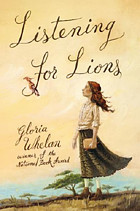
Thirteen year old Rachel Sheridan has been raised by
her English missionary parents in East Africa (Kenya) where her dad is a
doctor who runs a village hospital and takes care of the natives.
Rachel has never been to England and is truly a child of the African
soil. When the flu epidemic of 1919 strikes their village, Rachel's
parents make a valiant effort to save the sick, but end up dying, themselves.
Left an orphan, Rachel is faced with a terrible dilemma. Her conniving
English neighbors--the Pritchards-- have lost a daughter to the flu.
Because their daughter looked a great deal like Rachel, they put forward a
plan that would keep Rachel out of the orphanage--but would require her to
pretend she is Valerie Pritchard, their deceased daughter. She will
have to travel to England and visit Valerie's grandfather and keep up the
deceit--coaxing him to leave his estate to Valerie's parents. The
grandfather has cut ties with his greedy son for many years, but he feels a
connection to his only grandchild. When Rachel arrives at Grandfather's
estate, she tries to keep up the hoax. Grandfather Pritchard and Rachel
(Valerie) form a fast friendship, and they are both too smart and decent to
fool each other for long. Anyone who likes stories about orphans and
bright girls will enjoy reading this exciting, lovely story. |
|
|
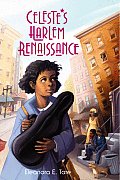
An historical novel, Celeste's Harlem Renaissance
by Eleanor Tate takes place in 1921. Celeste is a 12 year old
"colored" in racially divided Raleigh, North Carolina. Her mother
has died, her father has tuberculosis, and her Aunt Society (whose name fits
her) is her surrogate live-in mother. Her Aunt Valentina lives in NYC
and visits Raleigh now and then to brandish her lifestyle--full of theater, famous
people, and beautiful clothes. When Cece's father must be sent away to
a sanitarium for his health, Cece is sent to live with her Aunt Val in New
York. The reader peers into a time period--not that long ago--that is
unbelievably prejudiced and seemingly hopeless. But Celeste has spirit
and spunk--and she keeps on hoping and dreaming. She loves the
excitement and glamour of Harlem in the 1920's, but she also learns that the
city is not all roses. When she comes back to North Carolina to take
care of her sick Aunt Society, she discovers some difficult truths.
Writing this review one week after an historical election, one can understand
why the election of a black president is monumental for our nation and
history. |
|
|
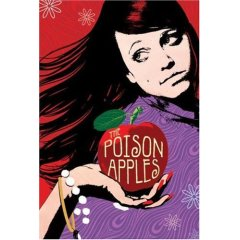
The Poison Apples by Lily Archer is clever, funny, and tender.
Told from the points of view of the three main characters, Molly, Alice, and
Reena, the reader meets their families. Each one is a tale of idyllic
childhood disrupted and broken by the break up of parents and the ensuing
marriage of their fathers to women who are nothing like their mothers.
These new "mothers" are, indeed, the equivalent of evil
stepmothers. When the girls meet at a New England boarding school, they
form a poison apple club to seek revenge on their step mothers. Molly
is from a small Massachusetts town, Alice is from Manhattan, and Reena is
from Los Angeles. Although their geographies and cultures seem to
separate them from each other in the beginning, their decidedly cruel fates
bring them together in humor and adventure. |
|
|
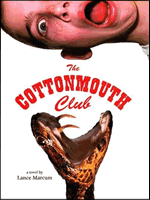
Here is another book I picked up because of the
cover; it's irresistible. The Cottonmouth Club by Lance Markam
starts at the beginning of summer vacation. Mitch Valentine and
his best friend, Tick, have made a list of all the adventures they are going
to experience. The reader feels the thrill of the end of school and the
idea of the summer laid out before him--and a quote right in the beginning of
the story amplifies that feeling: My dad's oldest brother once told me
that the thing he missed most about being a kid was summer vacation. 'Oh
sure,' he'd said in his slow West Virginia twang, 'we grownups git a vacation
ev'ry year, but it ain't the same. A body needs the whole summer, not jus' a
few measly weeks.' He'd gotten kind of a faraway look in his eyes and
squeezed my shoulder hard. 'You enjoy ev'ry durn minute of it, you hear?' What
a surprise for Mitch when his parents haul him off on a summer-long trip to
visit his "hick" relatives in Pitkin, Louisiana. However,
adventures can take place in more places than his California home.
Mitch, his brother, and his cousins are in for the thrills of a
lifetime--replete with snakes, middle of the night water tower climbs,
general mayhem, poor decisions, and oodles of fun. His cousins don't
seem so "hick" when the summer is over. |
|
|
I picked this book up because of the title. I
knew it had to do with sheep-herding because of the title/phrase, That'll
Do, Moss. Dog lovers will enjoy this book. Moss used to be a sheep
dog, but much happened to change him, not the least of which was being
attacked by coyotes and having his master move thousands of miles
away. Diane works for the busy Prager family who run a nursery
business. Besides babysitting their two younger sons, she oversees the
grounds and attends to the animals, including the dog, Moss. Diane thinks if
she can talk the Pragers into letting her prepare Moss for the sheep trials,
she may be able to help him overcome his depression. He needs to go
back to work. However, a rabid skunk, a rabies threat, and the
resulting hysteria of a few adults make her quest to help Moss almost impossible. |
|
|
I loved this book and found myself thinking about it
day and night. Every time I had to stop reading to work or eat supper
or do household chores, I eagerly waited for next few minutes I could get
back to its pages. The story opens with Nick Freestone, a thirteen-year old
boy living in London during World War II and the blitz on London.
Because the bombs are dropping close to his neighborhood, his mother sends
him to Burma to live with his father who owns a teak plantation. The
plot in a nutshell is that even Burma (Myanmar) is not safe from World War
II. Japan invades the country, Nick's father is taken prisoner, Nick is
forced to stay on his own plantation as a slave. He and his new friend,
Mya, attempt to escape cross country on the back of an elephant to rescue
Nick's dad and Mya's brother. It is the culture of Burma, the skill of
mahouts (those who work with elephants), the extraordinary faith and hard
work of elephants, the Buddhist monks--one in particular--and the
courage of so many good people that make this one of the best books in young
adult literature. |

|
|
Dandi Daley Mackall is the author of Larger-Than
Life-Lara. The narrator of the story is a girl named Laney. It is
from her point of view that all of the action happens. Until the story
begins, Laney has always been the kid in the classroom that the others made
fun of. However, when Lara arrives, the ridicule switches in Lara's
direction. Lara weighs over 300 pounds and has to have a special desk made to
accommodate her large body. Laney tells the story as though she were
writing a novel, making each chapter a sort of writing convention or
component, such as Rising Action. Lara would seem a
wonderful character to any reader, but seen through the eyes of Laney, she
rises to the level of sainthood. No matter how mean the children are to
her, no matter what they say or do, she holds no grudge, she shows no
revenge, she never rats on them. In fact, she often responds to the
abuse with poetry. When Joey Gilbert writes her a note that calls her a pig
and says she should try out for the part of the pig in the school play, she
stands up and says: Hey, Joey Gilbert, thanks for the note. / In a
class-clown election, you'd get my vote. / I watched you pitch, and I think
you're great. / But you'll get more power if your arm is straight." It
is Lara's indomitable spirit and Laney's struggle with what it means to be a
decent human being that make this little book outstanding. |
|
|
As the title (Football Genius) suggests, this
book is for anyone who loves football and all the intricacies of football
strategy. Troy is a thirteen year old football genius--he can see plays
coming and knows instinctively what needs to be done defensively to prevent
their success. Unfortunately, his coach treats him poorly, never gives him a
chance to play, and usually lets his own son, who is an inferior player, play
instead. When his mother gets a job with the Atlanta Falcons, his favorite
team, Troy gets a pass to watch the game from the sidelines. Because he
can sense the plays that are coming, he gets frustrated with the defensive
coach and tries to tell the players what to do. He is taken away by
security guards. After several incidents of deception, Troy gets the
star player for the Atlanta Falcons, Seth Halloway, to listen to him.
Together, they watch a televised football game and Troy predicts the plays
and what should be executed. There is much excitement as Seth tries to
convince the Atlanta Falcons coach and owner to give Troy a chance to show
his stuff. There is also a blossoming romance between Seth Halloway and
Troy's mom and between Troy and Tate. Most interesting about this book is
the author, himself. Tim Green is a former player for the NFL, a
valedictorian from Syracuse University, and a law graduate. He does
sports commentary on television and radio. He is a superb role model
for sports-minded youth. |
|
|
Okay, this is the sort of book you hate to have
end. Under the Mermaid Angel by Martha Moore is about Jesse, a
thirteen-year old eighth grader, who lives in Ida, Texas. Jesse is
smart, practical, and funny. She expects little from her small town--with its
laundromat, cafe, handful of churches, ordinary school, drugstore that doubles
as a bus stop, and plastics factory where most of the townspeople work.
When thirty-year old Roxanne moves in to the trailer next door, Jesse's life
changes. Roxanne has a tattoo on her chest, long flaming red hair, and
is a divorcee. Many of the women in town, including Jesse's mother,
think she has few morals. However, when Jesse and the others get to
know her, they find out she is a wonderful person, full of imagination, grit,
and love. Jesse has never forgiven herself for the death of her little brother,
William III. Roxanne also has some deep and hurtful secrets.
These two form a bond that transforms each of them. Besides this
beautiful story, several sub-stories are woven into the plot, including a new
girl in school, Debbie, whose face has been maimed in an accident, the local
doctor's son whose bad behavior "issues" are tied intricately to
the main characters, and the escalating Alzheimer's of Mr. Arthur, the museum
curator. |
|
|
Anthony Horowitz knows how to write thrillers for
adolescents. Evil Star is the second book in the Gatekeeper
Series. One of five humans chosen to save the world, Matt is sought by
a powerful organization -- the Nexus -- to travel to South America and
prevent the next world disaster. A combination of espionage, mystery,
horror, fantasy, and science fiction create the breath-taking action that
many of the young men in our school prize. This series is a popular
checkout. The story starts in England with Matt in a private school. He
is tormented by a bully--and ends up using his supernatural power for
retribution (to get even). Matt and his guardian Richard become separated
when they arrive in Peru, Matt is beaten by the police and escapes only with
the help of Pedro, a street urchin. Together, they set off around the
deserts and mountains of Peru, fighting against evil and seeking and
receiving help from virtuous people. |
|
|
This is a popular checkout in our library, so I
decided to find out why. Greg Heffley is in middle school and keeps a
journal of his experience in seventh grade. He is a hoot! First
off, he tells us right away that he told his mother to buy him a journal and
not a diary. He responds to his mother's purchase of a diary by
saying: Great. All I need is for some jerk to catch me carrying this
book around and get the wrong idea. I found myself laughing
out loud throughout the journal entries. Greg reminds adults of how we appear
to them--and also makes us remember what it was like to be in middle school,
ourselves. Much of the humor is found in the cartoon illustrations
which also add variety to the text and narration. |
|
|
In usual Willo Davis Roberts style, this is a
page-turner. Kaci loves to read mysteries and has a vivid
imagination. She often wonders what it would be like to have an
adventure of her own. Her Grandmother's saying is Be careful what
you wish for. Kaci's brother Jeff is house-sitting the neighbor's house
when it is robbed in the middle of the night. Kaci happens to look out
the window and see the flashlight shining through the neighbor's
livingroom. When he goes to investigate, Jeff is hit over the head by
the robbers, and the dogs are drugged. Thus begins the mystery of
robberies around town. When Kaci and her family move to their new house
in an upscale neighborhood, they hope to escape the crime that has been
escalating in their old neighborhood. Unfortunately, this doesn't
happen. Stay tuned as Kaci gets involved in the adventure of her
life--it's downright terrifying. |
|
|
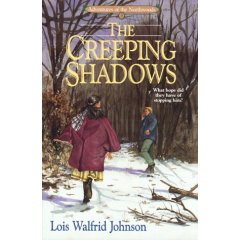
There are eight books in this Adventures of the Northwoods historical fiction series by Lois Walfrid Johnson. They are all set in the Northwoods of Wisconsin and will appeal to students who are looking for books with a Christian mindset. In this story, book 3--The Creeping Shadows, Katie O'Connell, the main character, lives with her mother and two step brothers while her step father is away working in a lumber camp. The year is 1906, it is the dead of winter, there are wolves, thieves, and even a bit of romance. Katie's heart goes out to the immigrant farm family who may lose their land and house to a loan shark because they are unable to make the payments. Even with all the poverty and hardships, the characters in this book are people from a time and place who always find a way to give to those less fortunate. The first five books are as follows: Book #1 The Disappearing Stranger |
|
|
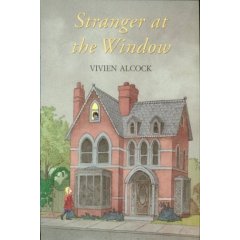
Stranger at the Window by Vivien Alcock starts as many of her stories
do--giving the reader a feeling of uneasiness or eeriness. Eleven year
old Lesley goes to London to stay with her maiden Aunt while her mother goes
on an extended trip. From the first night, Lesley notices a mysterious
figure in the attic window of the house next door. That house belongs to the
Harwoods, the mother whose soul purpose in life seems to be charity
work. She drags her three children, Victoria, Robert, and Christopher
around the city--donating and doing good works. She is so busy doing
charity work that she often overlooks her own children's nurturing.
When the three Harwood children are introduced to Lesley, they are not
impressed with each other: You should have seen Victoria's face: she
looked as disgusted as a cannibal being offered cauliflower with cheese.
The mysterious face turns out to be a young boy, an illegal immigrant, who
the Harwood children have been keeping and hiding from their mother.
When Lesley confronts the Harwood children about what she sees, she is taken
into the action and begins to help in the deceit. If you enjoy setting your
nerves on edge, you will like this story a lot. |
|
|
Layne's father was killed while bull riding, so his
mother isn't about to let him follow the same path. For Layne, the
passion is so strong that he disobeys his mother and begins practicing on the
neighbor's ranch. Chase Kincaid, a former champion bull-rider decides to help
him. Chase might be in his seventies, but he still knows a great deal about
the sport and he understands Layne's desire. There is a lot to interest
a middle school reader in this 92 page story--rodeos, Brahma bulls, a
good-looking neighbor girl, and a little sister who can drive her brother
crazy. |
|
|
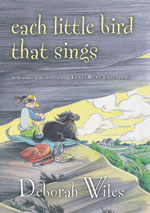
Each Little Bird That Sings by Deborah Wiles sounds strikingly familiar.
Those words are in the hymn, All Things Bright and Beautiful. This
hymn is often sung in the Snowberger Funeral Home, the setting of this delightful
story. Comfort Snowberger is the narrator and main character. The
children's names are Comfort, Tidings, Merry, and the dog's name is
Dismay. Here is a family that loves life and is aware of how precious
life is--probably because they live and work around death. The best way
to describe this story is to quote the beginning: I come from a
family with a lot of dead people. Great-uncle Edisto keeled over with a
stroke on Saturday morning after breakfast last March. Six months
later, Great-great-aunt Florentine died--just like that--in the vegetable
garden. And, of course, there are all the dead people who rest
temporarily downstairs, until they go off to the Snapfinger Cemetery.
I'm related to them, too. Uncle Edisto always told me, "Everybody's
kin, Comfort." Readers will laugh and cry with Comfort--and with her
dog, Dismay. |
|
|
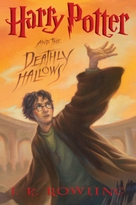
I have to admit that I have not been a Harry Potter
fan. This is partly because fantasy is not my favorite genre. However,
I have read three of this series. I read the first, the third, and now
the last. I thought Harry Potter and the Deathly Hallows was
spectacular. Sitting in my over-stuffed easy chair at home this summer, I
consumed the book, jumping to the front of the chair when there was
excitement. Just as I thought the pace was slowing and I could lean
back and relax, another stint of action would develop and I would jump to the
front of the chair. I physically hurt my back from rocking back and
forth to the action. Harry is a good wizard, and along with his community of
friends, he faces some very tough situations. I will not give away the
ending, but I will say that my very favorite part occurred when Mrs. Weasley
stood up to Bellatrix. I screamed with delight. Like ordinary
people and muggles, we all face tough situations. This book shows that
it is how we handle these situations that determines our character. |
|
|
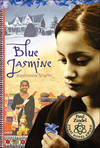
Moving away from home is never easy. For
Seema, the obstacles are over-whelming. She moves with her mother and
father and little sister from India to Iowa City, Iowa, where her father has
been hired to work at the university. She leaves behind
her cousin and best friend, Raju, her grandparents and her other extended
family that she has lived with since birth. With limited English skills,
Seema attends school in Iowa City and must learn the customs and ways of a
culture far different from her Indian home. The food is different, the
weather is different, the clothes are different, the plants are different.
When one of the girls in her 6th grade class begins to tease and taunt her,
Seema begins to understand how it feels to be on the receiving end of such
behavior. She begins to feel bad about how she treated one of her
Indian school mates, Mukta. This transforms Seema. She becomes more compassionate.
Blue Jasmine by Kashmira Sheth is a story about growing up. |
|
|
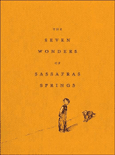
The Seven Wonders of Sassafras Springs by Betty Birney is a book about miracles. Set in a small Missouri town in the 1920's, the main character, eleven year old Eben McAllister, is dissatisfied with his surroundings. He longs to leave Sassafras Springs and see the seven wonders of the world. His geography book shows the Great Pyramid at Giza, the Colossus of Rhodes, the Statue of Zeus, the giant Lighthouse at Alexandria, The Hanging Gardens of Babylon, the Mausoleum at Halicarnassus, and the Temple of Artemis at Ephesus. When Eben's father asks him what a wonder really is, Eben reads the definition: a marvel; that which arouses awe, astonishment, surprise, or admiration. Thus begins the wager. Eben's father says that if Eben can find seven wonders in Sassafras Springs in seven days, he will buy Eben a train ticket to visit his cousins in Colorado. Even though he thinks it will be impossible to find one thing interesting in his community, Eben takes the wager because he wants to get out of town. His investigations lead to some great stories--stories that the people in Sassafras Springs have woven into their memories. There is a singing saw, a ghost table, truth-telling loom, and some unforgettable characters who have made their mark on this small community. This is the ultimate chapter book--each chapter a discovery--a miracle of life. The biggest miracle of all, however, is how Eben learns that what he thought of as ordinary is so extremely extraordinary. Sometimes, we have to open our eyes and our hearts to see the wonders all around us. |
|
|
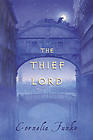
There is a familiar ring in The Thief Lord
by Cornelia Funke. For anyone who has ever read Charles Dickens' Oliver
Twist, the homeless children living together in an abandoned theater, and
Scipio--the Thief Lord--are reminiscent of Fagin and his gang of
pickpockets. Prosper and Bo, brothers, have run away from
Germany. Escaping their cruel aunt who only wants to adopt Bo, the
youngest, both brothers go to Venice. This is a place their mother had told
them lovingly about before her death. They hook up with a homeless
group of children: Hornet (the only girl), Mosca, and Riccio. Their
leader, Scipio, acts as a sort of Robin Hood, robbing the rich and giving the
goods to the children to pawn in antique shops. He also provides them
with a place to stay--an abandoned theater. Meanwhile, the plot gets
very complex. The aunt hires a detective to find the boys, the children
figure out that Scipio is actually from a wealthy family, a person from
the aristocracy offers them a bundle of money to steal a wooden wing, and the
antique store keeper they deal with is involved in the evil twists.
It is these last two actions that propel the story into a partial fantasy --
both terrifying and exciting. The story of the children's family of homeless
and destitute friends is a satisfying look at how a sense of community is
necessary for all human beings. |
|
|
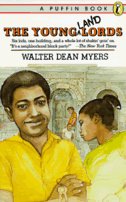
I really liked this book--The Young Landlords--by
Walter Dean Myers. The plot goes like this: A group of young
teenagers in Harlem decides to so something productive for the summer.
They form an action committee and make a list of possibilities. After
they eliminate world peace from their list, they settle on doing something
about a building in their neighborhood that is in disrepair and is an eyesore.
They seek out the current landlord, and before they know it, they have
purchased the building for one dollar. Now they are the landlords of a
tenement that has renters who do not pay their rent--and many of whom are on
the plus side of crazy. There are many little stories within this
framework that keep the reader engaged in what will happen. However, it
is the humor of the narrator, Paul, and his friends--and the way they see
their situations that is my favorite aspect of the story. I often laughed
out loud at the language and predicaments. There are some touching
moments in the story, too. As the narrator and his friends acquire more
experience, they begin to grow up. Their view of the world and of many
of the people they know begins to take on a kind of complexity that they
never before noticed. |
|
|
This latest book of Cushman's is set in the early
1950's. Students who build their background knowledge about this time
period will like the book much more than those who are not familiar with the
time period. Shortly after World War II, many citizens in our country
began to be suspicious of other citizens who were different. By different,
I mean people who might be of Russian heritage, might think differently about
politics or business, or might question the government. In fact, there
was one Senator in our country--Joseph McCarthy--who became well known for
calling people Communists and for organizing a kind of witch hunt to
prosecute Americans who dared to ask questions. In this story, Francine
goes to a Catholic school. She has learned to go with the flow, to
never question anyone about beliefs or social injustice. Then, Sophie
Bowman comes to town. Sophie is not afraid to question
authority, and she often asks the nuns provocative questions. After she
begins to hang out at the Bowman's and Mr. Bowman says she has unplumbed
depths, Francine begins to break out of her shell and think about
social justice and world problems: the atom bomb, bomb shelters, free speech,
Communism, and those who are put on the blacklist. The story is
often funny and heartbreaking at the same time. |
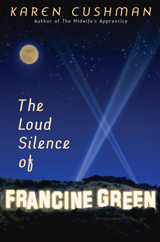
|
|
Naomi Soledad Leon Outlaw lives with her great
grandma and little brother in Baby Beluga--a recreational vehicle in a
trailer park in southern California. Naomi is a quiet girl who likes to carve
soap statues, make lists, and worry. Naomi and her brother were
abandoned by their mother when they were small and Gram is the only parent
they have really known. Naomi has vague memories of her father and
mother, but none of the details have been filled in until her mother shows up
one day and says she wants to get reacquainted with her children. Naomi's
mother has addictions and is not fit to be the children's mother. The
real reason she has shown up is because she wants to take Naomi to live with her
and her boyfriend and to be a live-in babysitter for her boyfriend's
daughter. Furthermore, she is not interested in Owen because as she
says, This kid's a blem. (comparing him to blemished shoes at the
local department store annual sale) Although Own has had several
surgeries for physical deformities, he is sharp as a tack. Naomi, even
in her childhood, can see right through her mother's scheming ways. When it
looks as though Naomi's mother has a legal right to custody, Naomi, Owen,
Gram, and their Hispanic neighbors, pick up their trailer and head for Mexico
to look for the children's natural father. The search for her father in the
Mexican state of Oaxaca is rather like looking for a needle in a
haystack. However, the annual radish carving contest held at
Christmastime brings the best artists from all over the country. And,
like Naomi, Naomi's father is a fine artist. This is a wonderful story of
extended family and neighbors who care enough about each other to go to the
ends of the earth. |
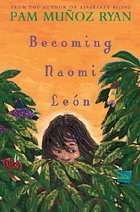
|
|
This book by Joan Bauer has all the ingredients of a
fantastic story: a 10 year old boy with determination, two great
friends, a bully, and a loving family. Mickey Vernon has been
playing pool since he was a little boy. His own father had been a
professional world champion before he died. Now Mickey wants to win the
Nine-Ball championship. Mickey's best friend, Arlen, a mathematical
genius shows him how playing pool is pure math, with geometry and physics.
Although this helps him with his game, he is still lacking confidence. Joseph
Alvarez, his dad's former best friend, comes to town and offers to teach
Mickey, but Mickey's mother has something against Mr. Alvarez. In
addition to the mystery and excitement, a pet pig named Mangler and a
girl named Francine add much humor. The pool tournament is narrated so
that you will be sitting on the edge of your seat. I jumped right out
of the chair when the cue stick hit the last ball. |

|
|
Rash
takes place a hundred years from now in a society that has become ultra
conservative. Bo, the protagonist, lives with his mother and
grandfather. His grandfather is always telling him about how things
used to be--including how it was to play football, which is now illegal. Bo's
only friend is his AI (standing for artificial intelligence) computer named
Bork. Bo's father and brother are in prison; in fact, most of the population
is in prison. Everyone who is not in prison is required to take safety precautions
that include helmets, masks, protective covering. When Bo commits his
third infraction (infractions such as not taking his medicine or calling a
fellow classmate a name), he is sent to prison in a frozen wasteland. In
prison, he overcomes the brutality and becomes part of a gang who plays
football. Bo's computer plays a big part in his unusual release
from prison. There is humor in this story, especially some of the dialogue
between Bo and Bork. There is also a larger theme about a society that
has taken away individuals' freedoms. The book is for mature audiences,
as the grandfather's language is occasionally harsh. |
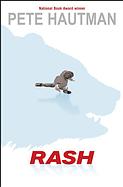
|
|
This book is uproariously funny. It starts off
with a tornado that rips up the graveyard and brings some caskets to the
surface. It does not disturb the librarian's grave, however. Her
epitaph reads: Electra Dietz--1851-1912--Shh--HERE LIES THE
LIBRARIAN--After Years of Service, Tried and True, Heaven Stamped
her--OVERDUE. Since her death, the town fathers have been too cheap
to hire another librarian--until the neighboring community's newspaper has an
editorial which shames the library board. The main character, Eleanor
McGrath (nicknamed PeeWee), is transformed by the new library science
students who come from Indianapolis to apply for the job. This story
has all the characters found in small towns, replete with hicks, villains,
and those who would enlighten them. |
|
|
Vive La Paris is Esme Codell's companion novel to Sahara
Special. This woman knows how to write stories for and from the
heart. Paris, an eleven year old, lives with her four brothers and
parents in a small apartment in Chicago. Her sensitive brother,
Michael, is bullied by a girl in Paris' class. This makes Paris
fighting mad--and it takes her aged, Jewish piano teacher, Mrs. Rosen, to
teach her that the only way to change bullies is to get to know them first.
Paris is hilarious. Some of the humor stems from her use of
language--she is very smart for her age, but the narrator sprinkles humor in
all the right places and the book will have you laughing out loud. It
will also make you cry and pound your fists in frustration--as the
characters, and humans, in general, sometimes treat each other in terrible
ways. |
|
|
Escaping the Giant Wave is another Peg Kehert thriller. Kyle and his family
are supposed to have the perfect summer vacation on the beautiful Oregon
coast. His hopes for getting away from Daren Hazelton, the school
bully, are dashed when Daren's family ends up going on the same vacation
since their mothers work in the same real estate company that is sponsoring
the resort conference. When the family arrives at the
"resort," it is nothing like the pictures. First of all, the
hotel is under construction, and instead of spending their week on the beach,
the family is put up in a run-down motel across the highway and away from the
ocean. Kyle's parents designate him babysitter for his smart little
sister, Dee Dee, and they leave to go on a work-related ocean cruise.
That is when the terror begins. An earthquake shakes the coast. The
motel falls apart and starts on fire. Everything is pitch black, and
Kyle and his sister have to get out of the wreckage. Kyle has studied
tsunamis in school and knows that earthquakes on the west coast can mean
giant waves will be headed toward shore. The drama is not resolved until the
very last page. |
|
|
Where the Great Hawk Flies by Liza Ketchum is an historical novel from the
American Revolution era. Daniel, 13, has a Pequot mother and an English
father. The story starts on Daniel's birthday, when a great hawk is
circling their Vermont homestead, signaling to his Indian mother an impending
message. At the same time, a new family has moved into a run-down cabin
next door. This family, the Coombs, has bad feelings about
Indians because they had been victims in a raid by Canadian Indians who sided
with the British. Several of their family and friends had been killed and
hurt. Now they view all Indians the same way. This
ignorance makes up the conflict in the story as the son in each family,
Hiram Coombs and Daniel Tucker, tells the story from his point of view. Mrs.
Tucker is well-known in the community as an Indian doctor and healer, but it
takes near tragedy for the Coombs to accept her. Besides this major conflict,
there are other struggles, one of which is how Daniel questions his mixed
blood and the the acceptance of his mother's and grandfather's Pequot
traditions. |
|
|
Another historical novel, Hitch takes place
during the Great Depression. During the 1930's people all over the
world suffered from lack of money and work--brought about by overwhelming
economic problems, a horrendous drought, and an inability to make a living
off the land. Franklin D. Roosevelt took over the presidency in 1932.
He proposed a program called the Civilian Conservation Corps--known as the
CCC. This government program employed two million young men around the
U.S. and became known as Roosevelt's Tree Program. Some of the jobs
included protecting natural habitats of wildlife, building dams, and planting
thousands of trees to help soil erosion. In Jeaneatte Ingold's novel,
the main character, Moss tells his story of CCC life. If you like
stories about the old days, this is a good one. Moss talks about the
hard life and the hard work, yet he captures the spirit of friendship and
loyalty. The title refers to the way people traveled then--they hitched
rides on railroad cars because they did not have the money to buy tickets. |
|
|
Paul Fisher is one of the most extraordinary
characters you will ever have the pleasure of meeting in a work of
fiction. Legally blind, Paul is a middle school soccer player who moves
with his parents and older brother from Texas to Florida. His father is
bent on having his oldest son, Eric, become a top-notch football player--and
thinks Florida is the place to get the recognition. From the beginning
of the book, Paul's journal entries cast a kind of foreboding feeling about
the move and the family, especially the brother, Eric. Eric may be a star
football player, but he has not a shred of decency in him. Weaved into
this main story are many sub-stories that include a picture of greedy
developers who have destroyed natural habitat to make money, an inner-city
middle school of lower income students--who as it turns out--have more
integrity and loyalty than anyone in the suburbs around them. This book
is for mature readers. Although Paul is a shining light, the tactics
and actions of his brother Eric are frightening and disturbing. |

|
|
On the surface, this is a fairy tale--the story of a
porcelain rabbit--replete with high adventure, narrow escapes, and passionate
characters. However, Kate DiCamillo has written a story that is not
just for children. Every adult should be required to read this
wonderful account of life. Edward's circumstances place him with a
young girl named Abilene, an old couple, a hobo, a sick child, and many of these
people grow roots in his heart. The rabbit's adventures are an allegory for
all our lives; each chapter could be a Sunday sermon that reminds us to open
our hearts to love. This is the only cure for the heartache that
results from loss and sorrow. Edward is our teacher. |
|
|
Anthony Horowitz, the author of the Alex Ryder
adventures, writes another set called the Diamond Brothers Mysteries.
This particular story, South by Southeast is the fourth one in the
series. Two brothers, Tim and Nick Diamond run a detective
agency. Tim is a loveable, but bungling investigator, while Nick has
the brains. The story reads so much like an old fashioned radio mystery
that the reader can almost hear the conventional mystery music. Take a
listen: This particular case
takes them to Amsterdam, as well as all over London and parts of England as
they try to keep an assassin from killing a Russian diplomat.
Horowitz is the master of pun. |

|
|
In Peg Kehret's Abduction, Matt, a
six-year-old, is abducted by his biological father from his kindergarten
class. Never having seen his real father before this, Matt is tricked
into the car because the man has also stopped by the house and stolen the
family dog. He tells Matt that "Pookie" is hurt and needs to
go to the vet. The rest of the story is the frantic search by Matt's
mother and his half-sister, Bonnie, to find Matt. The story often
shifts point of view as Matt is taken from place to place by his psycho
father. Eventually, Bonnie is caught up in the dangerous chase and the
two children must use all their wits and courage to escape and survive. |
|
|
In the first of Mark Williams' series Danger Boy
: Ancient Fire, Eli Sands experiences life through time travel.
"Thanks to my dad's experiments, and Mr. Howe's WOMPERS, I wasn't going
to move straight through from the beginning of my life to the end of it, like
everybody else. I was going to be twirled around in time and history,
like a smoothie in a great big cosmic blender." His mother,
already lost to a different time and space through the experimental lab, is
out there somewhere. Along with his new cosmic friends, a dinosaur and
a girl scientist from ancient Greece, Eli searches for his mother,
investigates a potential deadly disease, and tries to stay alive. The point
of view often switches to the dinosaur-like creature who is much more
advanced than humans are. He is writing a report for a school project
and when he describes human beings, he makes us seem kind of silly and petty. |
|
|
Carl Deuker writes a thriller in this book: Runner.
Chance lives with his alcoholic father on a small, run-down sailboat in a
marina in Seattle. He loves his father, but the roles of father-son
have been reversed. He takes care of his father, goes to school, and
holds down a part-time job to help pay the bills. The only enjoyment he
has is his pastime--running. When his father loses yet another job and they
are going to be evicted from the marina, Chance becomes desperate. A
man at the marina who has been watching Chance offers him a job--$250.00 a
week to pick up any packages he might find at a designated spot along the
path of Chance's daily run. He takes the job knowing he is involved in
illegal activity. It goes from bad to worse when the packages begin to
contain more than marijuana. Chance's predicament spirals downward as
the goons begin to watch him, his girlfriend and father get suspicious, the
fat man who hired him gets murdered, and terrorists get involved. If
you like to read books that will keep you up all night, this one is for
you. |

|
|
The Newberry Winner for 2006, this book reads like a
journal of youth. Lynne Perkins writes about teenagers on the brink of
discovery--finding meaning and friendship and love. They are growing to
adulthood. There are many poignant descriptions, some sad--some
funny. Although the story is very different, I got the same feelings
from reading this book that I got from reading The Human Comedy by
William Saroyan. There is a story about learning to drive a straight stick
that is weaved into the lives of a couple of the characters. Many
students could relate to this experience. |
|
|
Based on the Columbine shootings in Colorado a few years ago,
Myers' writes a gripping account of interviews, reports and diaries of three
fictional characters involved in a school shooting. This book is for
mature readers only and should be read in its entirety to comprehend the
theme--violence is never the right course of action. Part of what
makes this book compelling is how the interviewers, themselves, spin the
story--with their questions, attitudes, patience--or lack of patience.
Getting at the truth takes smart questions and time. One thing you
learn is that there are no simple answers. Trying to understand how we
think is hard -- even for us -- let alone for others. |

|
|
Time Windows by Kathryn Reiss is ghost story. Miranda moves
with her parents from NYC to a small town in Massachusetts. Her mother,
an obstetrician, and her father, a college professor, want to get out
of the rat race. They buy an old house on the edge of town-- a house
with lots of rooms and an attic. In the attic is a doll house that is
an exact replica of the house they have just moved into. Miranda
immediately discovers that she can see and hear the families who have
lived in the house before. The families have dark secrets and these
dark secrets seem to have a ghostly and ghastly effect on the present
family. Miranda and her new found friend and neighbor, Dan, must dispel
the ghosts. |
|
|
Geraldine McCaughrean writes this historical fiction
with such humor, authentic vernacular, and real character that it makes the
reader plunge into another time with ease. I could not stop laughing,
and I could not stop reading this book until I had finished. The story
takes place in 1893 in northwest Oklahoma territory. The settlers are offered
money by the railroad company to sell their claims--but they refuse. In
turn, the railroad company says it will not stop in their town of Florence,
and so the the plot is built around the residents thinking up ways to get the
train to stop. Most readers will fall in love with the town characters
and will not want the story to end. |
|
|
If you like funny and you like love stories, this is
the book for you. Gary Soto's Accidental Love is a perfect title
for a relationship that begins with mixed up cell phones. The main
character, Marissa, is a ninth grader in a tough city high school. It
starts out when she skips school to visit her best friend who is hospitalized
due to an car accident. Alicia has a broken leg, but worse than that,
she has a broken heart. When her boyfriend Roberto crashed into the
tree, the glove box came open--and out fell a picture of him with another
girl. Marissa is fighting mad at Roberto for what he has done to her
friend--so much so that she pummels him when the elevator in the hospital
opens and she sees him. The person she doesn't see, however, is Rene, a
rather small, brainy-looking nerd. It is his cell phone she mistakes
for her own during the melee. Their meeting to exchange cell phones
begins the transformation for both of them--what a great story. |
|
|
Just the cover of this book makes you want to stay up
nights reading. It takes place in two time periods. Joshua inherits all these
papers and pictures and diaries. It is his reconstruction of the stuff
that tells the story. Doug and Becca live in the 1920s. Somehow,
they have been separated from their parents and are now sent to have as their
guardian--their uncle--a ship captain. They become entangled in a
mystery that is both frightening and exciting. It will take a
determined reader to stick with them. The book is put together with
maps and pull-outs--and you sort of help solve the mystery as you read.
The author is Joshua Mowll. |

|
|
Cynthia Kadohata writes a story about a family of
Japanese ethnicity living first in Iowa, then Georgia. The story takes
place during the 1950's and is told by Katie, the younger sister.
There is sadness and prejudice in this book as you listen to the story of
Katie's family trying to make a living and trying to deal with
prejudice. Katie is just one of those characters who will steal your
heart. She has some of the same emotions other people have when they
love their family. When you are finished with this book, you will
probably want to keep a journal of your own life and turn it into a book
someday. Kira, Kira won the Newbery Award for 2005. |

|
|
This is a breath-holder story. When
Skiff's mother died, his father started drinking beer from morning to
night. Skiff's father used to be one of the town's best deep-sea
fishermen. Now, all he does is drink. The boat and the equipment
are falling apart. Skiff does what he can to save the boat and try to
make a living in this fishing village. As if it is not enough that he checks
200 lobster traps everyday in his small skiff, the town bully sabotages his
work. When Skiff decides to try and harpoon a giant tuna--well--just
plan on not putting the book down--because you won't be able to. |
|
|
Sahara Special is a story about a girl who is labeled Sahara
Special by her classmates because she has been part of a learning-disabled
classroom. Things change when, in the start of the year, the
class gets a new teacher, Miss Pointier. Miss Pointy, as the kids call
her, is wacky, wild, and wonderful. She is one of those people who find
the gifts in all of us, even when we don't think we have any gifts.
This is honestly one of the best books I have read. (Ms. O'Keefe) |
|
|
Danny is a terrific basketball player; he's fast,
smart, and dedicated. However, he's short. When he fails to make
the 7th grade travel team, he's devastated. His own father was on the
college team that won the national college tournament. So, his father,
who is divorced from his mother, comes back to town and starts a travel team
for the boys who were rejected from the other team. This is one of
those great sports stories with all the drama. Besides the basketball
story and its excitement, there is plenty of story associated with the family
break up and reunion. |
|
|
This is a short read. Owen is fourteen.
One summer after the annual vacation in the East Coast island cabin, Owen
hides in the sand dunes and refuses to return home with his parents.
The cabin is going to be razed and replaced by a palatial hotel and
resort. Owen does not want this to happen, and he decides to stay and
do what he can to prevent it. This cabin has been the only place that
is home for Owen, as his family has moved from city to city all through his
childhood. Going against his parents and encountering resistance from
the locals, Owen sets out to do what he believes is right in his heart. |

|
|
Will Hobbs knows how to write adventure stories,
maybe better than anyone. Robbie was born in and lives in a boat in the
Southeast Alaskan islands. One summer he leaves his family's boat to
find work aboard a sea-going troller. It's his goal to salmon fish long
enough to make some cash to help pay for college. Times are tough for
fisherman who fish for salmon. The salmon farming conglomerates have
taken over the industry and have caused the price to plummet. Robbie finds a
man named Tor Torsen who agrees to take him aboard for the short salmon
fishing season. What follows is one scare after another. Tor isn't just
a master sailor and fisherman, he is also psychotic. He has in his
possession three-hundred year old plaques that were planted by a Russian
explorer, claiming Alaska as Russian territory. His quest is to find
them all--and he needs Robbie to help him. There is a savage storm in
the Gulf of Alaska that will keep readers hanging on to their chairs as they
turn the pages. |
|
|
Al Capone Does My Shirts is simply superb. The setting is 1935
Alcatraz Island. Moose's dad takes a job as electrician and guard at
the prison so that Moose's sister, Natalie, will be able to attend a special
school in San Francisco. Although no one knew what autism was then,
Natalie's symptoms resemble the disorder. Moose struggles to live the life of
a normal 12 year-old boy, but it's not easy. The family lives in the
workers' quarters of the prison. He is often left to care for his sister,
whose sudden outbursts and withdrawals are difficult for anyone. He is
befriended by the trouble-making daughter of the warden -- and her schemes
often get him in big trouble. Many famous criminals are housed in this
prison, and the kids on the island do a lot of name-dropping in their San
Francisco school. This story has a wonderful mix of truth and
fiction--to make it one of the best historical novels available for kids of
all ages. |

|
|
Ida B. Applewood may be only ten years old, but she
is wise way beyond her years. Home-schooled by her parents on an
acreage of trees, Ida is a child of nature. She has none of the
self-consciousness and inhibitions often exhibited in other children.
In a way, she is the child in all of us, the child we wanted to be. She
says what is in her heart and her heart is good. When her mother gets
breast cancer, Ida B must go to school in town and her father has to sell off
some of the land for developing. She decides to harden her heart. If
you liked Because of Winn-Dixie, you will like this story. |
|
|
Esperanza Rising is the story of a young girl who lives the life of a
rich only child in a beautiful region of central Mexico. Her father is killed
by bandits and Esperanza's mother must either marry her evil brother-in-law
or lose the property. Instead, the two sneak away in the night with their
servants and travel to California to become farm laborers. This riches
to rags reversal occurs during the height of the great Depression.
Esperanza's rising is based on survival and friendships and compassion. |
|
|
Jasper is the perfect student. However, when
he is seated between Butch and Spike Couture for the year, his life
changes. Butch and Spike are a bad teacher's nightmare. Mrs.
McNulty is one of those teachers who does not deal well with surprises or
flexibility. Butch and Spike are funny and smart and they are a perfect
contrast to Jasper, who is used to doing everything by the book. A
transformation of all three boys comes from the mix--and is not what the
teacher had in mind. If you like stories with nasty teachers, naughty
boys, and large doses of humor, this is your book. |
|
|
An average student when it comes to grades, Therese
is extraordinary when it comes to wit and storytelling. She is assigned
to do the coveted Ethan Allen report, but since she doesn't like
"research," she spends little time looking for accurate
information. Therese is from a family of French farmers whose ancestors
settled in this area of northern Vermont. The story brings together the
clash of educated versus uneducated people and city-folk versus
country-folk. The main character, Therese, is an example of an adolescent
who has this conflict in her own character. She is embarrassed by her
family at the same time she is proud of them. She is aware that
learning is important, but she is not sure why. All of these conflicts
are sure to be familiar to most teenagers. The book is also a
gut-wrenchingly humorous. |
|
|
When three foster children become a problem for
Father Matt's wife, they are sent with his disabled sister and his uncaring
housekeeper to a summer cabin. The housekeeper absconds with all the
money, and the children and the sister must figure out a way to
survive. If they admit to Father Matt that they are in trouble, the
children will be separated, and Mrs. Bradshaw, the sister, will not be
allowed the freedom she needs to rehabilitate. Together, with
resourcefulness and courage, the four characters, who have been neglected and
mistreated form a bond to create their own family. |
|
|
For the reader who likes adventure, this is the
book. The ingredients include: a group of boys, summertime, a rookie
Willie Mays baseball card, an abandoned mine, a plan to determine who gets
the baseball card, and all the foils that go into any plot worth its
salt. The main character of Patneaude's story, The Last Man's Reward,
must overcome a number of obstacles, some of them dangerous. |
|
|
Weirdo's War by Michael Coleman is a page-turning survival
story. The main character, Daniel, is a mathematical genius. He is also
a loner. When his father forces him to go on a wilderness school trip
with his bully P.E. teacher, he doesn't expect to have fun. However,
the experience is worse than he could ever have imagined. He is teamed
up with other bullies who do their best to humiliate him anyway they
can. This is a story that pits brains against brawn. The twists
and turns leading to its conclusion are frightening and surprising. |

|
|
The Broccoli Tapes by Jan Slepian takes place during a spring semester
in Hawaii. Sara and her family move to the largest island from Boston,
while their professor father is taking a sabbatical. Living on a finger
shaped peninsula formed from volcanic ash, Sara and her brother find the move
a difficult adjustment. While exploring the lava rock formations, they
rescue a wild cat and begin to feed it. Meanwhile, Sara is recording a
living history project for her class back in Massachusetts. Since her
father is allergic to cats, they must keep this a secret--and thus begins
their adventure. Their dying Grandmother and their new friend, Eddie
Nutt, add conflict, confusion, and depth to their lives. |
|
|
This is a feel good book. Granny comes over to
her granddaughter's house every Saturday to cook with her. These
Saturday cooking sessions become the format for storytelling and
counseling. Rosie, who is very much like her grandma in temperament,
can be read by her grandma like a book. Rosie is going through all the
normal growing up things--best friends, jealousy, confusion, extreme highs
and lows in her feelings. Grandma recognizes these looks and words and
begins to tell Rosie stories about her own childhood and about her own
growing up. Bailey, who is Rosie's best friend--and a boy--is
involved in much of the cooking and counseling. Grandma's stories are
poignant and often funny, too. Slowly, Rosie begins to see the
connection. The reader feels the power of families and their stories. |
|
|
Another exciting deep-sea fishing story, the main
character, Robbie, learns from his step-father. He not only learns how
to be a superior first-mate, but he also learns how life and problems are not
simply black and white. Running a charter deep-sea fishing business
sounds like fun, but Robbie and his step-dad have to contend with customers
who aren't always the best of people. The catching of marlin and
dolphin are some of the most exciting parts of the book. Did you know
that once a beautiful fish is taken -- that its brilliant colors begin to
fade as the life goes out of it? |
|
|
This story is a page-turner. Bobby Marks is
fifteen and weighs over200 pounds. He spends summers at the lake with
his family, and he is too embarrassed to be seen in a swimming suit. He has
been made fun of for most of his life. In this coming of age novel that
takes place in the 1950's, Bobby deals with dangerous bullies and
prejudice. With dogged determination and a sense of humor, Bobby Marks learns
to stand up for himself and find self-esteem. |
|
|
The House of the Scorpion by Nancy
Farmer takes place in the future, probably about 200 years out. The main character is Matt, a clone. The book could be read by a competent 5th
grader, but it could also be enjoyed by a 99 year old. Although the story is full of complexities,
the plot and action could satisfy the most reluctant readers. |
|
|
Sparrow
Hawk Red by Ben Mikaelsen is a riveting
adventure/mystery. It takes place in southern Arizona. The main
character, Ricky Diaz, is the only child of his pilot father. His
mother has been killed in a car accident--or so he thinks. One day he
hears the real story--and he is determined to "fix"
things. He sneaks into Mexico to avenge his mother's murder. Not
only does he learn about the dangers of spying on drug dealers, but he also
learns about the injustices inflicted on the homeless and needy. |
|
|
This 2003
Newbery Award Winner, Crispin, is set in medieval England in the 14th
century. Accused of a crime he didn't commit, the thirteen year old orphan is
forced to flee his village. Staying alive during this ordeal is an
arduous task, but recognizing truth and happiness in the process involves the
miraculous. |
|
|
If you liked the movie Back to the Future,
then this book is for you. To prevent his mother's death, Jack travels
back in time to the 1940s, only to find a love that can never be. This story
is an intricate weaving of the past and present. One of the most
interesting themes has to do with fate: Are human beings predestined to
live and die according to a set plan, or do we have some control over the
direction our lives take? Is there any such thing as fate? |
|
|
In the middle of the 1800's, the potato blight in
Ireland caused many to emigrate to America. One night, Nory is awakened
by an awful smell that comes wafting in through the open doors and windows.
Her grandfather instantly recognizes the smell of rot from the potato fields
--- the potatoes are rotting while still in the ground. Even Nory knows what
that means: They may actually starve to death. So begins Nory's struggle to
stay alive. |
|
|
Elliott's story is woven together with vivid
historical details from World War II, appropriate for adolescents who seek
suspense-filled adventures. Henry's B-24 is shot down over Nazi Germany in
1944. His escape is one narrow one after another, as he is helped by
the French Underground to find safety. The courage of the French Underground
and the good they did during WWII are a main part of this book's revelation. |

|
|
A Girl Named
Disaster is a wonderful story that takes place in Mozambique and Zimbabwe.
Nhamo, the protagonist, is a young girl who is being forced to marry an older
man who already has three wives. With her wise grandmother's help, she
escapes the village and goes in search of her biological father. This is a
challenging read for a student who is looking for excitement and
adventure. |
|
|
When LaMarr's mother flies off with her boyfriend
pilot and doesn't return, LaMarr is sent to live with her aunt and uncle in
the deep South. Her immense loss and loneliness force her to put the
pieces of her life together and to look at people differently. Anyone who
has ever suffered loss and change would find this book highly appealing. |

|
|
Although Patrick Henry was a famous statesman and
contributed much to our country's founding, his home life was very sad.
His wife, Sarah, became mentally ill after the birth of her youngest son,
Edward. Rather than commit her to an asylum where the conditions were
deplorable, the family kept her locked up at home. This story is told
from the point of view of the two oldest daughters and is compelling in every
way. |
|
|
Winner of the Coretta Scott King award for tolerance
building, this is a marvelous set of portraits about kids in the inner
city. Not only do we get to know about them and their lives, they get
to know more about each other. A creative English teacher assigns
poetry writing to be read on Fridays during open mike poetry jams. It
is hard to believe this is fiction--the author, Nikki Grimes, makes the
characters believable and worthy. |

|
|
Ben has a summer job on Martha's Vineyard as a first
mate on a charter boat. On the first day of work, he spies a brand new
Porsche under water near the dock. The car belongs to a wealthy tourist
who is missing, and the police suspect drugs are involved in his
disappearance. The plot thickens as Ben gets involved with a local
juvenile and finds himself in the middle of a dangerous situation. |
|
|
Alex Ryder is the teenage James Bond of
fiction. This is the third book in the series, and each one and each
chapter is full of riveting exploits and narrow escapes. This one
includes illegal nuclear weapons, Chinese gangs, and the Wimbledon Tennis
tournament. Most creative are the gadgets that Alex has at his disposal
to help him escape or gather evidence. |
|
|
Here is a short read, written all in poetry.
The narrator, Jack, is a young boy who is grieving over his dog's
death. Sharon Creech masterfully weaves the poetry of some
well-known poets into the fabric and ideas of this very touching story. |

|
|
Will Hobbs is once again a champion of the
environment. This story is set in modern day Seattle. Cody and
Shannon have come to stay with their uncle who works for a wild life rescue
operation. One time, they must get a trapped coyote out of an elevator in the
middle of the city. This and many of the rescues raises all sorts of
ethical and philosophical questions about why so many animals are out of
their habitat. Rapid City kids can relate--we just had a moose wander into
our city limits this fall. The pain, suffering, and eventual recovery
of the animals parallels that of some of the characters, too. This is a
marvelous story. |

|
|
Howard travels with his father in 1916 back to his
father's boyhood home in southwestern Illinois. The main story, however,
comes in the form of a flashback, starting in chapter two. The boy's
grandmother reveals the family's history. Tilly Pruitt lived in the small
Mississippi River town of Grand Tower along with her brother Noah, her frail
little sister Cass, and their mother. One day, their town is turned on end
when two mysterious young ladies step off the riverboat. Tilly's mom, in need
of money, invites them to stay at their home. The mystery
surrounding these girls, the mean-spirited townspeople, the ensuing horrors
of the Civil War--all this and more make The River Between Us another
Peck spectacular. |
|
|
This book is hilarious. Jake Semple
exemplifies the middle school kid who rebels against authority and seeks
attention by spiking his hair, piercing every part of his body, and getting
kicked out of every school he goes to. However, he meets his match in
attention-getting when he is sent to stay with the Applewhites. Here is
a family of such creative genius and talent that they basically lack common
sense. Only E.D., the middle child, is blessed with organizational
skills, and Jake is assigned to home school right along with her. Life
is always at full throttle in this family of writers, artists, dancers,
directors. For laughs and great story-telling, Surviving the Applewhites is
the book. |
|
|
Jake is left with his dad's dog after his dad's
funeral. However, Jake doesn't like this wolf hound as much as his
father had. Instead of calling him Jim Amigo, Jake calls the dog Jim
Ugly. Known for its tracking ability, the dog keeps looking for his
master and takes off. For a variety of reasons, Jake doesn't believe
his dad was in that casket and he takes off to follow the dog. This is
a western. It is replete with bounty hunters, guns, saloons, and the wild
west. It is also a story for dog lovers. Tune in to see how the trust builds
between Jake and his dog. |
|
|
Qwerty Stevens forgets to write a history report due
in one hour. By using his Anytime Anywhere time travel machine, 13-year-old
Qwerty goes back in time, meets Benjamin Franklin, and finds out about the
American Revolution. However, even in such fantasy, complications arise -- a
curious teacher, a crazy man who wants to steal the time travel machine, and
Ben Franklin sitting on Qwerty's bed -- are just a few of the problems.
This is humorous, as well as an interesting way of learning a great deal
about revolutionary America. |

|
|
Ella Enchanted is a wonderful fantasy about a girl, Ella, who has
been cursed since birth. She must obey every command given to
her. Ella's mother tells Ella that she must tell no one about the curse
because it will be used against her. In Cinderella fashion, Ella's
mother dies and her father marries a wicked woman with wicked daughters.
They figure out that Ella can be commanded, and her life becomes
miserable. Amidst love for the prince and dangers everywhere, Ella sets
out to find the fairy who cursed her and have her undo the fate. This
story has a fascinating and exciting plot, but even better, the theme of how
we affect our own decisions and fate gives the story depth and merit. |
|
|
Eleven year old Alma lives in an Hispanic
neighborhood in the Southwest. With a mother working two jobs, a
teenage sister with a baby, and a brother who is in a gang, Alma has to
search hard to find happiness. She loves music and spends her time
listening to the radio and is crushed when the rock star she idolizes,
Jovita, is killed in a drive-by shooting. To escape the harsh reality
of her household, she begins to sneak into the neighbor lady's house.
Mrs. B is a music teacher and has many C.D.s and musical instruments.
When her brother and his gang follow her into the house and burglarize the
place, Alma calls the police. This is a book of breathless events.
Readers are easily absorbed in the story and want for Alma to succeed. |
|
|
The 2004 Newbery Award winner, The Tale of
Despereaux is the epitome of fairy tales, complete with hero, villain,
princess, love and forgiveness. One of the book's attributes is the
narrator, who frequently talks directly to the reader and inserts her humor,
as well as her two cents worth. This is an easy read for children, but is also
chock full of symbol and allegory for the reader who needs more
complexity. Recommended for children from six to ninety-six. |
|
|
This book is delightful. It has all of the
attributes of the kind of books we look for: humor, pathos, friendliness,
nostalgia, love, conflict, excitement, hope, heartbreak, and experience we
can all relate to. It is easy to read, yet rich in thought. Most
everyone who reads this little book gives it top rating. The narrator, India
Opal Buloni, goes to the Winn-Dixie grocery store and brings home a stray
dog. She names him after the store, and Winn-Dixie affects everyone he
meets in this summer of fun. |
|
|
If you like Harry Potter books, then most likely
this book will suit you. The author deftly mixes fantasy with reality so that
the reader is drawn easily into the suspense. Anand, a 12-year
old, lives with his mother and disabled sister in one of the poorest
sections of Calcutta. His father has abandoned the family, and they
have gone from a well-off life style to one that has them scraping for
sustenance. One day, Anand is kind to a beggar. The man (a seer)
follows him home. Because he is compassionate, Anand has been chosen by
a brotherhood in the Himalayas to return the spiritual /mystical conch.
Together, Anand and the seer begin their journey. The journey is one
quest after another--full of peril and joy. |

|
|
In Rebel we meet a young girl who has
been marching to a different drummer since the day she was born. Almost six
feet tall at the age of fourteen, Amanda, named Rebel by her family, does not
fit the mold her parents would like her to. Instead of going to Europe
with her family, Rebel stays home to help her grandma fix up a rooming house
near the University of Washington. Her grandmother's friend's grandson
also helps. Moses is also cut from a different cloth, and he does not
want to be a lawyer like his parents want. Instead, he is
interested in filmography. He carries his video camera everywhere.
One day, when the two are out for a walk, they film a hold-up at a
convenience store. When the thief drops his billfold, they pick it
up. It has no identification, but the twenty dollar bill inside turns
out to be counterfeit. The two of them set out to solve the crime and
end up in a precarious situation when the criminals begin breaking into the
boarding house to retrieve the evidence. |

|
|
Minuk
is one of the series: Girls of Many Lands. Published by
American Girl, these are historical fiction written in a kind of documentary
style. Minuk and her sister are fascinated by the new white
missionaries who have come to their village in Alaska. They possess
modern conveniences--like wood stoves. Minuk is a quick learner and
soon picks up English. Although the missionaries are modern and seem to
want to help the natives learn about medicine and health, they are not very
tolerant of the Yup'ik beliefs. |

|
|
Hattie, 12 years old, doesn't know she has an
uncle. One day her parents and grandparents sit her down and tell her
that her uncle Adam is coming home. Returning from a school that's just
closed and whose existence is kept quiet by adult family members, Adam is a
21-year-old man with a child's mind and a passion for I Love Lucy. He
can repeat every episode word for word. Hattie is upset with her
parents and grandparents for not telling her about Adam. She
turns out to be very good with him, and she ignores the taunts of her
schoolmates as she takes Adam around town during the summer break. Anyone
who has ever lived with and helped care for a special needs person will love
this book--full of heartbreak and promise. |

|
|
Ten year-old Willow Jones and
her little brother are left by their drug-addicted mother for the
weekend. She doesn't return, and the old woman they are staying
with dies. Willow's brother, Twig, was born a crack baby, and Willow is
the only one who takes care of him. In desperation, she reads through
some old papers and finds her grandmother's name. With determination not to
be separated from her brother by social services--and her encouraging inner
voice, a character named Red Mouse, Willow gets in touch with her grandmother
and the two children fly from Vancouver to Ontario to meet relatives that
they do not know. This is a very engaging story about a courageous young girl
and her disabled little brother. |
|
|
Gossip and slander are familiar occurrences to
almost everyone, even to gossipers and slanderers. The protagonist of
this story, Bird (Burdette) is a wide-eyed optimist, as well as a disliked
7th grader. When another misfit moves to town, Bird attempts to
befriend him. Harlem is shunned by his classmates because they think he
is dumb. Bird has to overcome some of her own prejudices to find out
what Harlem is really like. Fame and Glory in Freedom, Georgia is a
fast and delightful read. |
|
|
Everything that Richard Peck writes turns to
gold. Fair Weather is a delightful story set in Illinois in
1893, the year of the Chicago World's Fair. The narrator, 13 year old
Rosie, and her family live on a farm in Christian County, Illinois.
Anyone who has ever lived or worked on a farm will appreciate the
authenticity. They receive an invite from their estranged aunt from Chicago,
inviting them to come to the world's fair. Grandpa, a rascal of a
character, goes along with the grandchildren as a
chaperone. This contrast of poor, honest, bumbling country folk with
the glitzy, putting-on-airs city folk makes for much hilarity. |
|
|
A Long Way From Chicago is about two kids from Chicago, Joey and Mary
Alice, who visit their grandmother every August--in her small country
town. She is the epitome of the eccentric relative, the one who can
embarrass you to death but can redeem herself in a minute with her heart of
gold. The novel is set up so that each chapter is its own short story. In the
very first chapter, Grandma gives a comeuppance to a nosy reporter and a
gossipy local woman. Every chapter is fun and funny. |
|
|
Winner of the 2001 Newbery Award, A Year Down
Yonder is a sequel to A Long Way From Chicago. Mary Alice is
now a teenager. Because of the depression and hard times, her parents
send her to Grandma's to live and go to school. Hard times in small
towns show up faster than they do in cities. Yet, the survival skills of the residents
surpass those of their city counterparts in many ways. Grandma is still
eccentric, full of energy, embarrassing, and hilarious. Those eccentricities
bother Mary Alice at first, but she eventually sees through these
quirks and oddities--and comes to love her grandma. |
|
|
This 2000 Newbery Winner by Christopher Paul Curtis
is perfect for reluctant readers of any age. The story takes place
during the depression of the 1930's. Bud lives in an orphanage, where
boys are often farmed out to foster families. His last experience with
a mean foster family who lock him in a cold and dark shed to sleep is the
last straw. He decides to run away and find his father. The only
possessions he has are posters of a jazz band that he has been carrying
around since his mother's death. He believes the band leader is his
dad. His journey to find his father leads him across Michigan in dangerous
times. This is a sensitive and compelling page-turner. |
|
|
The Watsons Go to Birmingham is an absolute treasure of a story. The year is
1963 and the Watsons, an African American family, live in Flint Michigan.
Narrated by the 10 year old son, Keith, the descriptions of the 13 year
old son, Byron, and the little sister, Joetta, are hilarious. Byron's
attitude and behavior will make anyone who knows a typical 13 year old laugh
and cry. The parents are funny, too, and like parents of many
teenagers--worried about Byron's direction. To teach him that his life
is not as bad as he thinks it is here in Michigan, the Watsons decide to
drive him down to Birmingham, Alabama to spend the summer with his
grandma. At the height of the civil rights movement, Alabama is a
frightening place. This is a book that never gets tiring and can be
read over and over. |
|
|
Searching for David's Heart requires the reader to bring a box of tissue.
This is a gripping story about a girl whose brother is run over by a
car. Darcy blames herself for her brother's accident. When her parents
agree to give his organs for transplant, Darcy and her best friend, Sam, set
out to find the person who received his heart. Although that describes the
plot line, there is much more to the book that engages readers:
friendship, parenting, death and dying, homelessness, social justice. |
|
|
This 1973 Newbery winner is still a favorite for
most any teenager. Julie, or Miyax--her Eskimo name, is strongly
influenced by her father's traditional ways. She is taken away from him
and sent to live with her aunt. She is betrothed at the age of 13 and
runs away, trying to get to San Francisco, home of her pen pal. However,
she gets lost on the frozen tundra of the Arctic. Because of her early
training in all aspects of dealing with nature, Miyax encounters a pack of
wolves and learns how to communicate with them. She becomes a member of
their family, and because of this, they help her survive. It is the
surprising climax of this story that makes it memorable. |
|
|
Abbie stands behind the tree and watches as her dad
leaves his girlfriend's apartment. Angered by her father's abandonment
of the family, she throws rocks and breaks the windows. Of course she
is caught and sentenced to community service in lieu of a record or reform
school. Her assignment is to be the companion of an elderly woman, helping
the lady in any way she needs help. Mrs. Merkel, however, is not your average
elderly lady. Cantankerous is the best of her descriptions. She
likes to solve crimes, and she is more than a busy-body. She actually
makes Abbie drive her around to spy on people. This exciting book turns
into a page-turning mystery thriller, complete with murder, attempted murder,
and robbery. |
|
|
Mary Downing Hahn's historical fiction Promises
to the Dead takes place during the beginning of the Civil War in
Maryland. Because it is a border state, the impact of this war seems
even worse than in states whose sympathies lie with one side or the
other. Jesse, a white boy, finds Lydia, a slave, giving birth in
the woods. Lydia dies in childbirth, her baby dies, and she makes Jesse
promise to take her seven year old son, Perry, to his aunt in
Baltimore. Perry has been fathered by Lydia's white owner. This sets
off a chain of frightening events and escapes. Jesse, only twelve
himself, must deal with danger and conflicting feelings about white people
and their view of slavery. |
|
|
Hazel is the daughter of a physicist who is called
to Los Alamos in 1943 to work on the development of the atomic bomb.
The entire community on the Hill, as it is called, is composed of
scientists, their families, and others commissioned to do this secret work.
No one in the community is allowed to talk about the work, and only the men
who work in the tech area really know what is going on. Hazel is smart,
however, and very curious. She is always asking questions. Her
mother, too, is not only aware of what is going on, but she is also what we
would refer to now days as a conscientious objector. She falls into a
deep depression because she knows that the work will result in a deadly bomb
that will kill innocent human beings. During her stay there, Hazel
meets and makes friends with memorable characters. Her life and the
lives of all the people who lived there were forever changed by their
experience. Where the Ground Meets the Sky by Jacqueline
Davies is historical fiction at its best. |
|
|
Wow! This is one of those page-turning
thrillers that mystery lovers are looking for. I recommend this book
for better than average readers because the number of characters, the dialect
of 19th century England, and the intricate plot make for a challenging
read. However, if you are often bored by banal, predictable writing,
try this. Phillip Pullman begins his story just like this: She
was a person of sixteen or so--alone, and uncommonly pretty. She was
slender and pale, and dressed in mourning, with a black bonnet under which
she tucked back a straying twist of blond hair that the wind had teased loose.
She had unusually dark brown eyes for one so fair. Her name was Sally
Lockhart; and within fifteen minutes, she was going to kill a man. |
|
|
On her twelfth birthday, Tulip changes her name to
Hope. Her mother left her with her Aunt Addie when she was a
baby. She and her aunt have lived in several states--her aunt working
as a cook and Hope as a waitress. Whenever they leave a place, Hope
always writes Hope was Here. Hope longs to find her father and longs
to stay in a place long enough to grow roots. However, Hope and Aunt
Addie must go where there is a job. This latest move to Mulhoney,
Wisconsin from Brooklyn is a tough one. Hope must leave behind some
good friends and the city for which she had grown quite fond. However,
this small Wisconsin town turns out to be the setting of quite a story. There
is romance, mystery, heartache, love, friendship, politics, and all the
stuff that make life worth living. Joan Bauer is superb at metaphor and
simile--making the art of waitressing and cooking parallel the hospitality of
life. |
|
|
Hayley Cox accompanies her brother's girlfriend,
Annie, to Siberia to see where her brother, John Cox, died.
However, Annie doesn't believe that John is dead. Even though she is in
a wheel chair and unable to walk, Annie is full of grit and determination to
get to the bottom of the mystery. They both end up in the midst of a
mafia plot that puts them and everyone who helps them in the path of
danger. At the same time the girls are looking for John, he is
struggling to find his own path to safety and freedom. Although the
story's plot is highly exciting, the sophisticated reader will find much
more. The sacrifice some people make to help others is phenomenal. |
|
|
Mick Harte Was Here is an easy to read story that causes an equal
amount of tears and laughter. Told from the point of view of Mick's
sister, Phoebe, the story journals her brother's death and the family's
efforts to cope with their grief. Phoebe says, ...it hit me
that we were way in over our heads. This was one of those tragedies
that needed a family that knew what it was doing. Like the Kennedys or
the Queen of England and her whole bunch. It's when Phoebe finally
realizes that forgetting about her brother is not what she has to do.
Instead, what she and her family have to do is remember everything about
him. Her recollections of this amazing kid are wonderful. |
|
|
Gerald is left alone by his drug addict mother when
he is only three years old. He plays with a lighter, starts and fire
and barely escapes death. Gerald's aunt is given custody, and for the
first time in his life, he finds love and security. However, when he is
nine, his aunt dies and Gerald is forced to go live with his mother, sister, and
step-father. Supposedly his mother has turned over a new leaf. However,
she hasn't. He loves his sister, and he tries to protect her from
the abusive step-father. His battles seem to never end, but Gerald is a
remarkable kid, centered with what is right in life. This book is a
hard look at the realities of kids who suffer from abuse. It gives
phone numbers at the end for readers who might want help or more information
about domestic abuse. |
|
|
Matthew Morgan and his geologist father move to an
Eskimo village in the Arctic Circle. His father is bent on exploring
and finding copper deposits in the frozen north--deposits that will make him
a rich man. When he sets off on an expedition and doesn't come back,
Matt and his Eskimo friend, Kayak, take off on a snowmobile to find
him. The temperature is forty degrees below zero, the wind is vicious,
and the terrain is frozen sea that juts up in dangerous ridges and wide
cracks. Their gas spills, they are forced to walk, they run into a
polar bear, they have near death experiences throughout the adventure.
Matthew has been educated in Arizona and at first thinks Kayak is
ignorant. However, it is Kayak's knowledge and understanding of Arctic
nature that keeps them alive. Matthew begins to see that there is more
to life than making money. |